

For today’s 31 Days of Halloween Vol. II post on The Monster Club (1981) I have left out a few things to try to keep focused on what I am covering. Specifically, I do not mention the Amicus Productions angle to the film, not do I mention Donald Pleasance. I do not think the post is going to suffer for a lack of covering these two elements, but they also just didn’t feel essential enough to the main point.
With that said, let’s turn our attention to this underappreciated Halloween-vibes film, shall we?
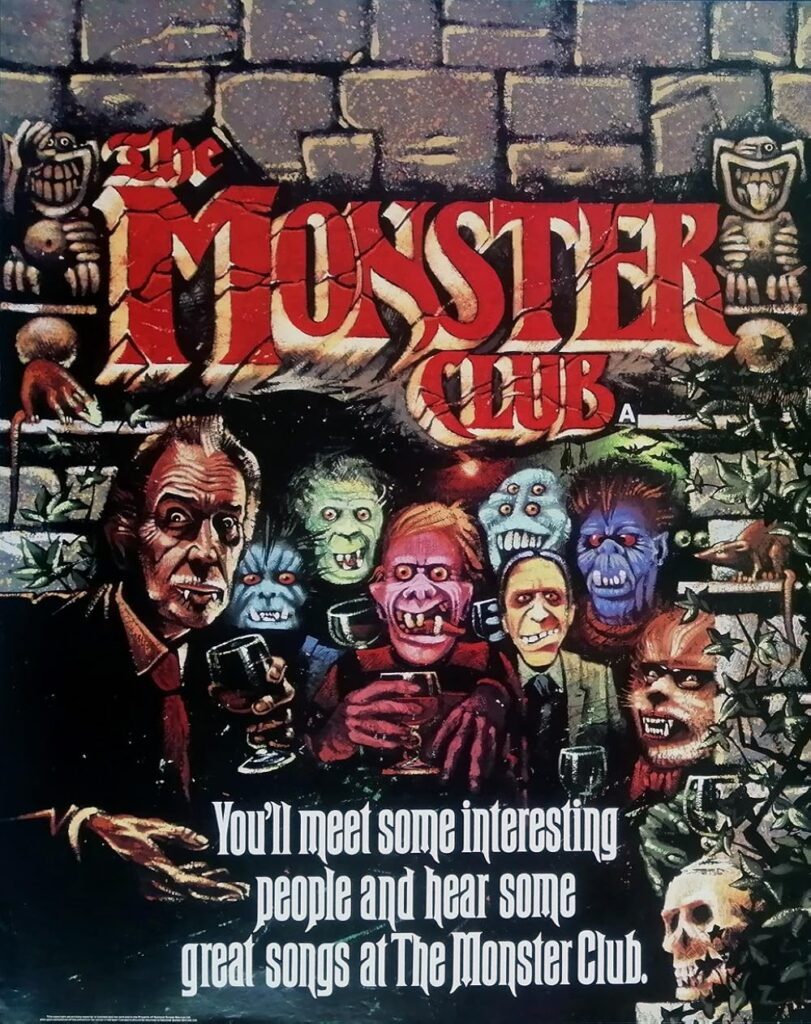
The Monster Club, from 1981, is a fun little anthology film that was a critical and commercial flop, but has found a bit of a cult following because of its very specific blend of monsters, British horror aesthetics and fantastic soundtrack. Is it the best horror anthology film out there? Not really, but it was certainly a much better and more cohesive anthology than V/H/S/Mixtape. I don’t think it is a movie for everyone and it’s not really all that frightening, but it’s a movie I tend to watch in October just because the vibes are immaculate.
Monsters!
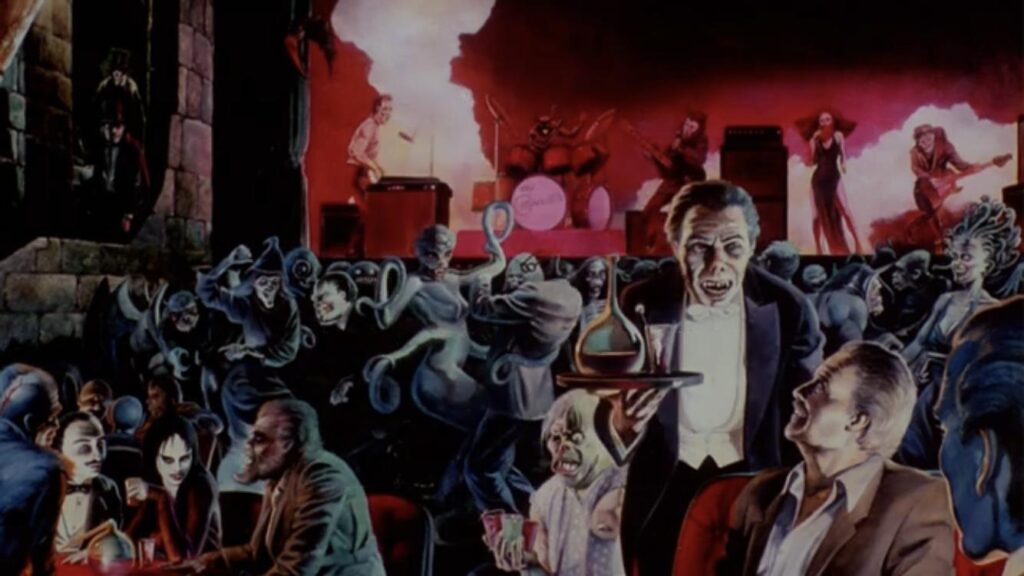
One of my favorite things about the look of the film is that there is a very low-budget feeling to all of it. With the exception of a handful of “hero” monsters, most of the costuming and make-up effects on the assembled monsters are very simple consisting of fangs or very stiff masks. Every monster looks overly humanoid and the whole crowd looks like they raided a Spirit of Halloween and took every weird mask they could find. Barring a decent Wolfman-style look for the club secretary, most monsters tend to look like awkward extras trying to emote through masks they cannot see through.
Vincent Price, appearing as a vampire, looks virtually unchanged from his normal appearance in 1981. The man’s aura just gives vampire, so no need for much in the way of prosthetic fangs either.
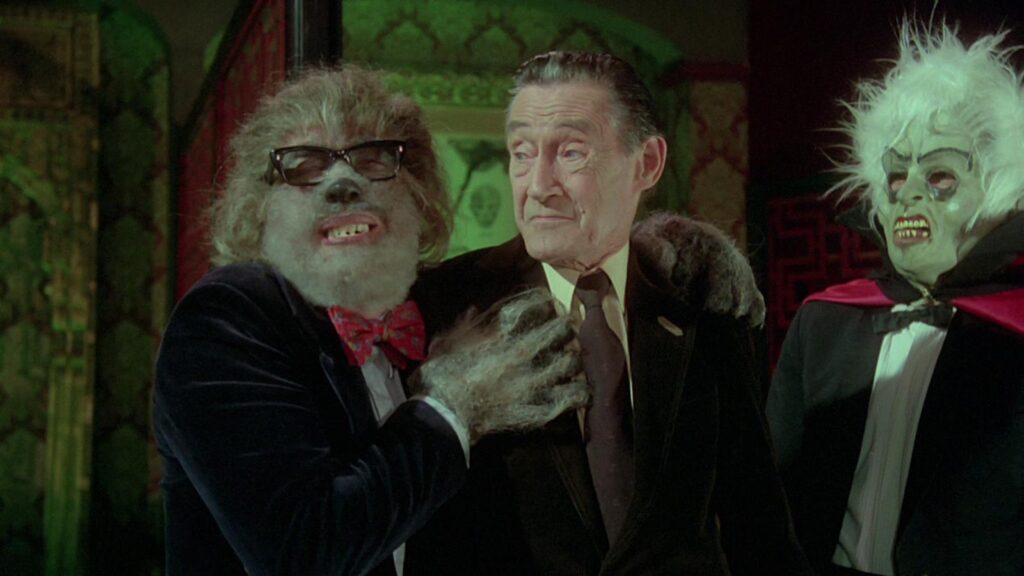
The look of the film is cheap, or more to the point, budget-friendly, but that has its own charm. The club segments, depicting the author R. Chetwynd-Hayes (John Carradine), an adaptation of the real author, and Erasmus (Vincent Price) skirt the line between family-friendly and having just enough edge that The Monster Club comfortably earns a PG rating. Nothing is too gruesome in the anthology’s framing device, though the shorter films within vary wildly. But, to the point of budget, the film establishes a world of wacky monsters only for the feature segments to focus on very human-looking creatures. The film sets this up in a rather interesting way, but the movie is at its most fun with the punk-rock haunted house energy of the wraparound segments.
Music!
Speaking of punk rock, the soundtrack of The Monster Club is one of the things most readily appreciated by fans. With that said, none of the music is technically punk, aligning more with new wave (which is a derivation of punk, but don’t tell the punks that). The punk attitude of it all comes from a kind of carefree and goofy vibe in the club scenes that matches that mad monster-party on the screen. Among some of the bands involved were BA Robertson, The Viewers, UB40, Night, and The Pretty Things. A number of the musical sequences also turn out to be some standout, memorable scenes.
The film’s main theme, The Viewers’ “Monsters Rule, OK!” is an addictive little earworm that should be included on more Halloween party playlists if it is not already. It’s campy, upbeat, and fun, and has a joyful quality that sounds like Halloween in my head.
In one of the less family-friendly moments that whips around back to camp, Night’s track “Stripper” features an electric little strip-tease that transitions into an animated segment where the stripper, down to a black silhouette against the stage, proceeds to strip off her own flesh, leaving a seductively gyrating skeleton. There’s nothing particularly graphic about any of it, but then again, I’ve never watched a stripper with my parents or any children, so your mileage may vary.
The induction of R. Chetwynd-Hayes into The Monster Club at the end of the film, because after all, humans are the real monsters, also is accompanied by The Pretty Things’ “Welcome to the Monster Club” – a mellow, reggae-tinged jam about being accepted by the other monsters.
Again, I cannot stress enough just how fun this soundtrack is. It also happens to be the aspect of the film most frequently documented and written about. In fact, there are more songs on the soundtrack that did not make it into the film, as covered by Perfect Sound Forever in a write-up.
Maybe subconsciously I am just trying to get people to see the movie to expand their music playlists at home. I used to play a lot of these tracks back when I was doing my radio show, The Mutant Hours.
Monster Genealogy!
In one of the weirdest conceits of the film, Erasmus takes time to explain the genealogy of monsters to R. Chetwynd-Hayes through a convenient genealogy chart inside Erasmus’ booth in this club. Does it make sense why this chart is there? Absolutely not. Do these distinctions between these monsters make sense? No, they do not. But is it goofy and fun? Absolutely.
The film’s three central anthology stories are all based on exploring traits of these different monsters, including shadmocks, vampires, ghouls, and humgoos. Maybe it’s just best to let Erasmus explain it:
So as Erasmus lays out, monsters have a distinct genealogy, and different monster breeding results in further branches. For example, a vampire and werewolf breeding results in a werevamp. Whereas werewolf and ghoul would produce a weregoo. A vampire and ghoul gets you a vamgoo, and so on. The variations get even more specific there, but as Erasmus lays out, one just needs to remember the “basic rules of monsterdom” which is pretty simple: “vampires suck, werewolves hunt, and ghouls tear. Shaddies lick, maddies yawn, and mocks blow. But shadmocks only whistle.”
Of course you may be wondering what a shadmock is. It’s simple, again, you fool: If a mock were to mate with any of the other hybrids, you get a shadmock, who can’t mate and only whistles, but doesn’t do it very often due to melting people’s flesh off their bones when they do.
It’s not complicated at all.
This is one of the elements of the film I adore the most. It fully commits to this odd worldbuilding and features Vincent Price rattling off these variations of monsters completely straight-faced like it’s common knowledge. The film’s central segments focus specifically on the shadmock, vampire, and humgoo – the humgoo being the offspring of a human and ghoul.
And humans do not get left out, the film culminates with an impassioned and adoring speech by Erasmus, arguing that humans deserve their place among the kingdom of monsters. The case is made, R. Chetwynd-Hayes, much against his will, is inducted as a member of the monster club and they all dance. The genealogical determinism here is sharply pointed and lends the film a satirical edge at its end that doesn’t quite land. You get it, yes, but it feels a little undercooked in the film as a whole.
Even then, if R. Chetwynd-Hayes doesn’t want admission, I’ll gladly take his place. Those shadmocks know how to party.
This has been an installment of Graphic Content; support my writing by joining me on Ko-fi.
