



Today we are on to essay #7, which is about 1978’s Halloween! Be sure to catch #6 if you have not read it.
Anyway, here is more writing about horror. Please comment with your thoughts if you’d like, or send it to someone who might enjoy it.
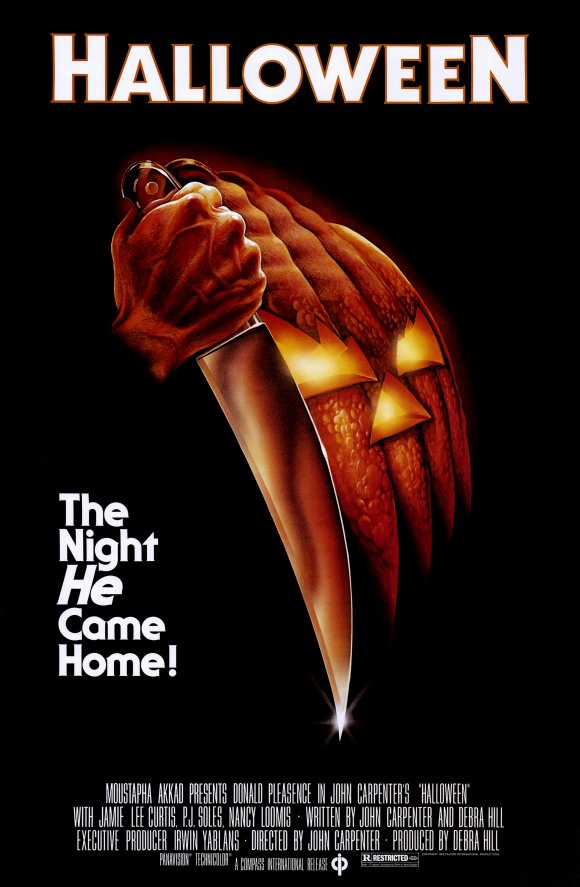
When I last tackled Halloween (1978) back in the first 31 Days of Halloween collection, I saved it for my final film of the project. In that essay, I looked at the concept of “The Shape” and the Bogeyman and how Carpenter and Hill’s film created a modern manifestation of a Bogeyman concept. Halloween: a modern fairy tale that utilizes the uncanny to convey a lesson. But Myers, as a folkloric derivation, works best the less you know about him. Case in point, from the essay: “Yet, we can never truly understand Michael; that is what is most terrifyingly effective in the first film and why successive films actively work against this representation of unknowable evil.”
So this time, I wanted to write about evil, again. This time not regarding folklore or the supernatural, but rather the mundane nature of Michael Myers in that first film.
He is only a man, and a man can commit great evil.
An Avatar of Evil?
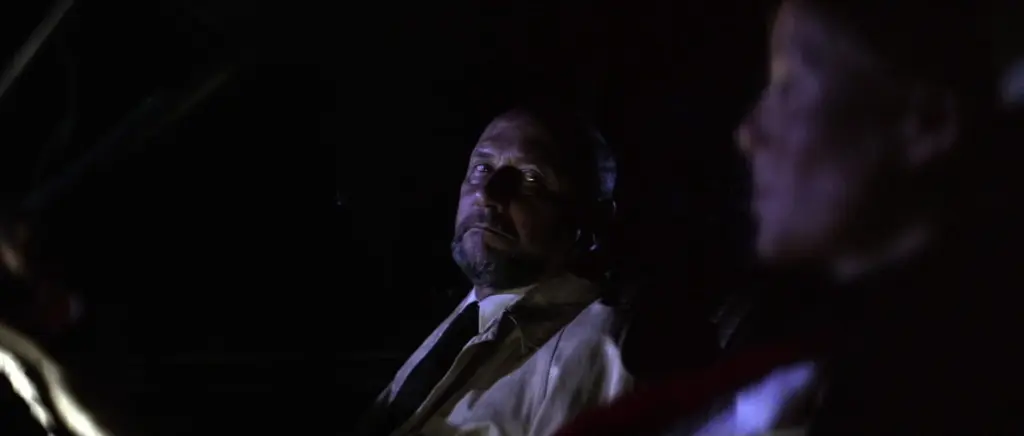
As much as Dr. Loomis personifies Michael as true evil (“The devil’s eyes.”), he is still very much a man and the film frequently shows this. So many people sometimes see Michael as supernatural in the first film when really that is because they have been conditioned to think that. Dr. Loomis’ framing of Michael as a near-supernatural avatar of darkness colors much of how viewers see Michael’s actions and seemingly supernatural swiftness. Michael is a large, fit man upon his escape from the asylum and very quiet with occasional exceptions. It could be that Michael Myers is just naturally stealthy, can’t it? In this case, Loomis’ paranoia infects the audience, coloring their perspective on Michael’s actions when there are perfectly human reasons for his perceived ability to disappear in the dark of a poorly lit suburban neighborhood or in the chaos of a nocturnal asylum breakout in pouring rain.
Again, it is Dr. Loomis who puts the supernatural evil concept into the audience’s mind, continually warning Sheriff Leigh Brackett of the evil that comes to Haddonfield. Michael does not become supernatural until the “Thorn trilogy” of Halloween films, though, through an ancient Celtic curse. The reality is much more frightening than the idea of Michael being a supernaturally tinged avatar of evil; Michael Myers is just a disturbed, strong man with no remorse and a grim sense of humor. He is human after all.
The Human Nature of Michael Myers
One element of Michael Myers presented in Halloween is that he appears durable. People interpret this as being supernatural, but nothing in the film really suggests that beyond how viewers interpret him recovering quickly from some pretty rough blows. By the time Michael Myers starts taking on some real damage, the audience has already been indoctrinated by Dr. Loomis. As for the injuries themselves, Michael receives about ten of them. Laurie handles the first three, while Dr. Loomis is responsible for the other seven:
- Stabbed in the neck by a knitting needle
- Wire coat hanger to the eye
- Knife wound to the chest
- Six revolver shots to the chest and torso
- A two-story fall from the blunt force of the revolver shots
Michael never expresses real pain from any of these beyond a grunt or groan. Compare Michael’s lack of reaction to the terror and shrieking of each of his victims. Michael’s durability is not supernatural, but it is extreme. That does not make him inhuman, though. Though one cannot be blamed for believing Michael is supernatural, his uncanny rising from the ground, simply sitting up from being on his back, does a lot of heavy lifting here. Nick Castle’s intense core strength creates such a shocking moment, often duplicated in numerous slashers later on.
One of the humanizing elements of Michael Myers that makes his evil acts all the more chilling is a simple practicality. Michael is stealthy and has a good sense for survival. Consider Michael’s escape from the asylum, where he takes advantage of the breakout to steal a car. Loomis later finds a mechanic’s truck abandoned with signs that Michael has taken the man’s clothes. Of course, Michael isn’t all there; he is a madman after all, and continues to use the asylum’s car he stole as he stalks Haddonfield during the day.
Speaking of the car and practicality, though, it is quite funny in one particular scene to see Michael practice safe driving. As Dr. Loomis is speaking with Sheriff Brackett in front of the hardware store that Michael broke into, the escaped killer can be seen in the car at an intersection in the background, with the mask on and looking both ways for oncoming traffic before making his turn. It is a small moment that many people miss, but is hilarious if you think about. The avatar of evil practices road safety. It also reflects one of the funniest lines in the film: at the asylum, when Loomis is told that Michael cannot drive a car, Loomis responds, “He was doing very well last night! Maybe someone around here gave him lessons!”
Of course, there is also the case of little Lonnie Elam, the bully of Tommy Doyle. Lonnie, having bullied Tommy as the school day ends, darts into the foreground only to collide with Michael, who does nothing beyond letting the kid go on his way. Why does Michael let him live? Because it is not practical to murder a child in daylight. It is as simple as that.
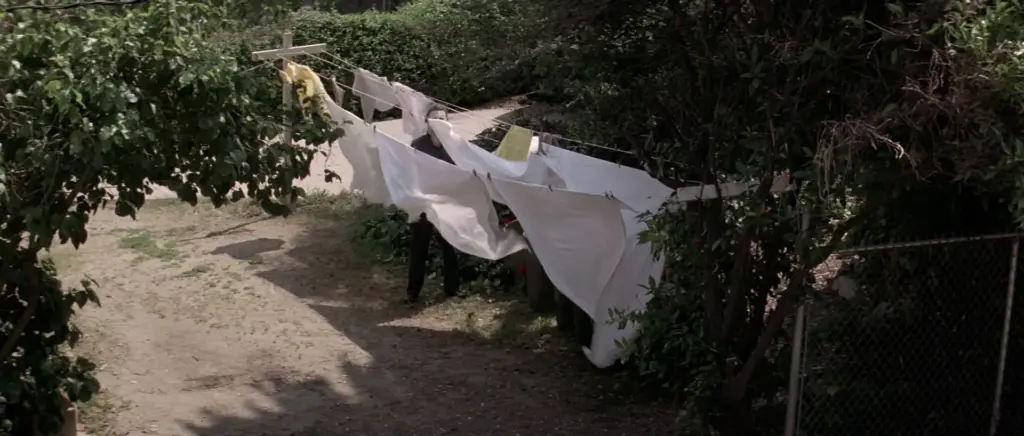
Michael’s stalking is another curiously humanizing element to the killer, as in many ways it feels like Michael is playing a game with people. Famously, Laurie catches glimpses of him throughout the afternoon – behind shrubs, down the road, in front of a laundry line. It is so childlike you could almost be convinced that Michael Myers is a disturbed child who never grew up. Of course, to err is human, and Michael’s playing around does cause him to slip up. As he watches Annie in the kitchen, his hand rests on a hanging planter on the back patio. He puts a little too much pressure on it, though, and it crashes to the ground, giving away his position. In that moment, you get to see Michael perform his disappearing trick, confirming it is not supernatural at all. He’s just quick to react and hide himself in the darkness.

Michael’s inquisitiveness is one of the more interesting touches in the film. He sets his sights on Laurie because she is a random person who came to his door. He does not know this girl, but he stalks her and sets his sights on her and her friends just because of his inquisitive nature. Later, as the body count continues to grow, Michael kills Bob, the boyfriend of Laurie’s friend Linda, and something very curious happens. Michael holds Bob aloft and jams a knife into his chest; it is apparently the world’s strongest knife because it can anchor Bob to the cabinet door a few inches off the ground. In any case, Michael stops and stares at his handiwork, seemingly studying what he has done; filmed in distant profile, you can make out his head tilting. What can we make of this? Could it be pride? It is one of the stranger and most human elements Michael Myers presents in the original Halloween.
Lastly, one of the more interesting human touches that complicates the reading of Michael Myers is his sense of humor. While his evil is not meant to be funny, there is a gallows humor aspect to his methods. Specifically in two scenes, Michael’s creativity has a cruel, humorous edge. The first one is Michael’s “ghost costume,” where he approaches Linda wearing a bedsheet with an eyehole cut out. But what makes this even more bleakly funny is that he also has Bob’s glasses, over the sheet, on his head. This is enough to convince Linda that it is Bob having a goof.
It is not Bob having a goof, though.
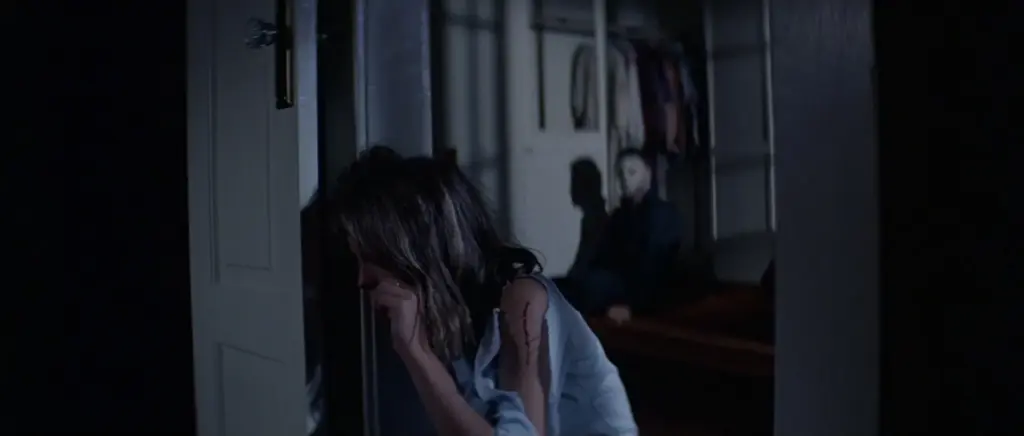
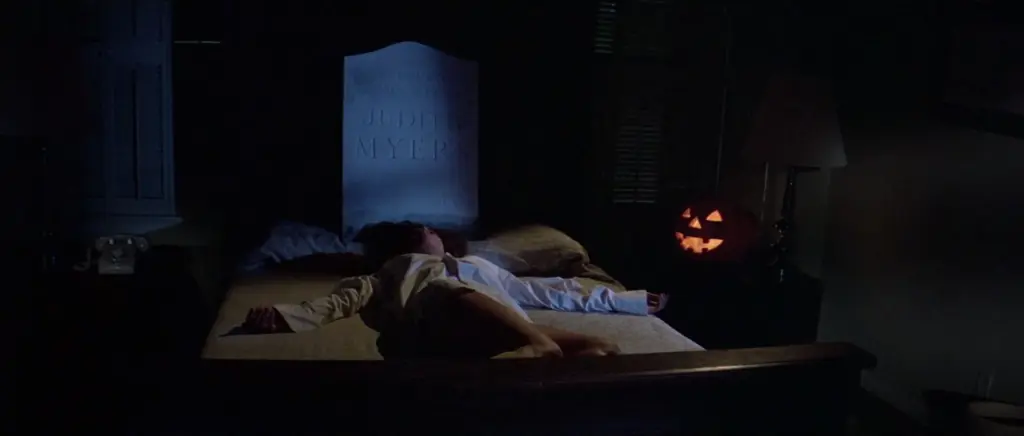
Of course, the other major dark joke is Michael constructing a house of horror with the remains of his victims that Laurie stumbles into, including gags such as Bob hanging from a closet and Linda shoved into a linen closet that was ajar enough to open. The centerpiece, however, is the cruelest joke of all: Annie’s corpse propped up against the tombstone of Judith Myers, his sister, stolen from a cemetery earlier that day.
Michael understands the grim irony of all of this and chooses to comment on it through a disturbing art installation. He’s not completely incapable of understanding his actions like Loomis supposes. Michael is smart enough to know what he did and find a meaning in it, and he cunningly makes a statement in mockery of it.
Banality of Evil
Political philosopher Hannah Arendt covered the trial of Nazi bureaucrat Adolf Eichmann in 1963. It was in her coverage that she coined the phrase “the banality of evil.” Eichmann was just a man whose unsettling complicity in one of the most monstrous systematic eradications in world history did not carry a supernatural influence of the cruel cackles of a demonic evil. Eichmann was a quiet, detached figure who efficiently plotted and administered a system of horrors to eradicate an entire ethnic and religious group.
Loomis’s rants about the unholy evil he sees in Michael Myers in the first film largely become literalized in popular culture. Michael has the “devil’s eyes,” as described by his doctor, a man who is meant to treat Michael, but according to Loomis, Michael cannot be saved. There is nothing to save. Loomis’ failure becomes a cosmic mythology to explain away the doctor’s inability to fix a disturbed man. Instead, Loomis intends to radicalize anyone he speaks to about Michael, partially to remove a dangerous man, just a man, from Earth, while also emotionally coping with his own inadequacies and doubt.
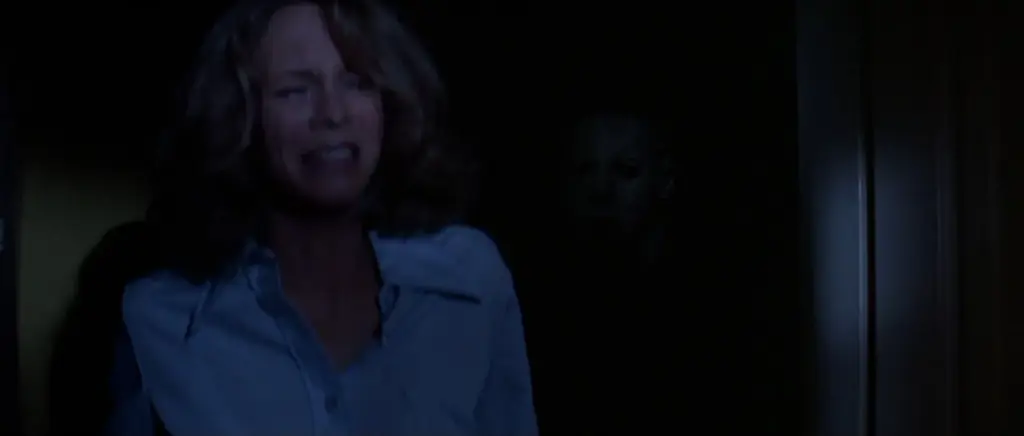
But the truth is that Michael is just a human being. Granted, he is a violent and disturbed human being, but not a supernatural avatar of any devil or demon. Loomis is broken by this and makes it everyone’s problem.
Evil isn’t always a curse, demon, or shadow. Evil sometimes is a murderous child who waits patiently to kill again, shrewd and childlike. Evil does not have to be supernatural, but the concept of an otherworldly influence sure helps us to handle the anxiety created by the simple truth: some people are just born bad.
This has been an installment of Graphic Content; support my writing by joining me on Ko-fi.

People really do forget that certain people are capable of committing such atrocities. And for some reason people think that just because someone has a large stature that they’re a lumbering, loud oaf. As a tall queen with a large silhouette, it would be expected that i am loud when I walk. In actuality im very quiet and often scare people without trying. The thing is people aren’t expecting to have someone walk behind them; so they don’t look for them. Michael is just really good at that especially because he doesn’t make any noise. His breathing is always under control, he doesn’t talk, and because he’s not rushing his foot steps have little noises to make.
As for his durability? He either doesn’t feel it or he doesn’t care. The likelihood of all his injuries not killing him is unlikely, but the possibility is there. Stabed in the neck with a knitting needle? Are we sure it was th neck and not that Michael has some hella thick lats? Stabbed in the eye? Although painful it is very surviveable. Plus who’s to say it punctured the eye. It could miss the eye and hit the socket. Knife wounds are survived often. Shot 6 times? Loomis is a doctor not a police officer or equal thing. Fall from 2 stories? It really just depends on how he landed. Again survival would be unlikely for him, but not impossible.
[…] covering. Specifically, I do not mention the Amicus Productions angle to the film, not do I mention Donald Pleasance. I do not think the post is going to suffer for a lack of covering these two elements, but they […]
[…] films. From here, the franchise would end up regressing into a kind of arrested development around Halloween (1978) and Halloween II (1981) and lack the ambition, misguided as it was, of the wildly experimental era […]
[…] back to John Carpenter’s Halloween and Dean Cundey’s predatory camera, the found-footage approach feels like such a good evolution […]
[…] make for a more cohesive whole than most of the entries in the franchise, with the exception of the Halloween (1978)/Halloween (2018) pairing. I appreciate the ambition of Zombie’s approach and willingness to go […]