


A bit late for Halloween: The Curse of Michael Myers (1995) for 31 Days of Halloween. Had just about the worst migraine of my life and couldn’t do a damn thing. I’m still not entirely over it, either, but I am doing what I can.
Unfortunately, comes the end of the wildest and longest strange Halloween continuity out there, and everything is played it safe from here on out. Is Halloween: The Curse of Michael Myers any good? Not real. But it does have Paul Rudd, and we can be thankful for that.
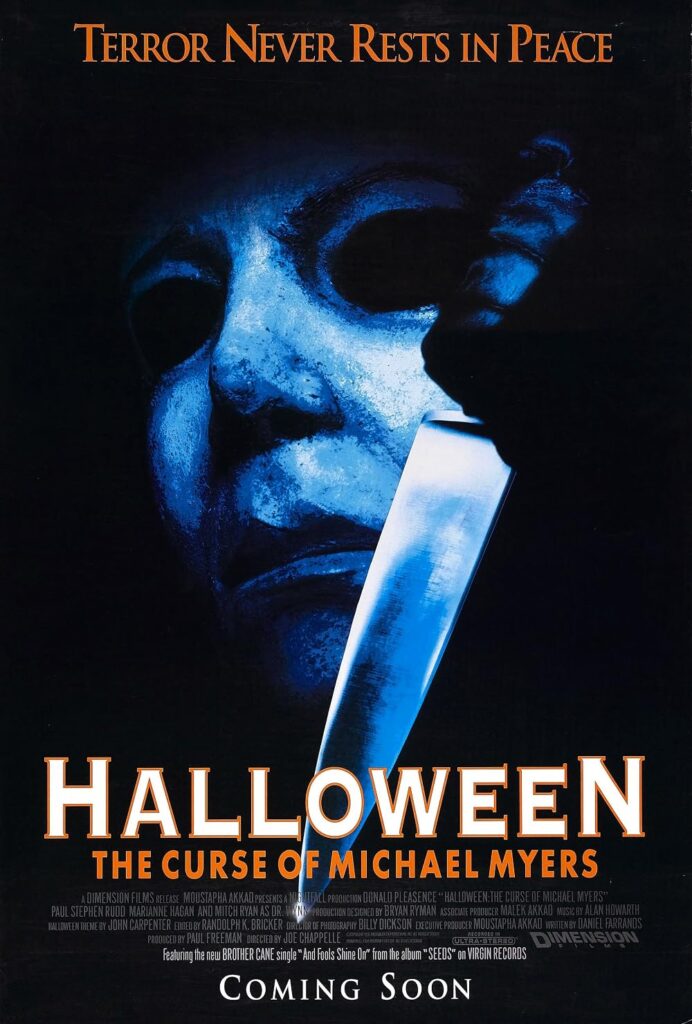
With Halloween 6, or more accurately, Halloween: The Curse of Michael Myers (1995), we reach the end of the single longest continuity of the franchise and the first split in what is now acknowledged as a Halloween multiverse. It is really strange to think about, but Halloween’s longest continuity consists of only five films. From here, the franchise would end up regressing into a kind of arrested development around Halloween (1978) and Halloween II (1981) and lack the ambition, misguided as it was, of the wildly experimental era of five original films in the Michael Myers story.
As far as the continuity goes, it’s pretty simple. People like to overcomplicate these things.
The first timeline consists of the first two films, Halloween (1978) and Halloween II, and then moves into the “Thorn” trilogy of Halloween 4: The Return of Michael Myers, Halloween 5: The Revenge of Michael Myers, and Halloween: The Curse of Michael Myers (dropping numbers entirely). This is the timeline that has the most radical transformation of the franchise and moves Michael Myers into a supernatural figure.
The second timeline is a reboot version, but only a partial one. This continuity features Halloween and Halloween II, but includes the film Halloween H20: 20 Years Later (1998) and then Halloween: Resurrection (2002). This is the “sister Laurie” timeline that focuses on the Michael and Laurie relationship, especially following the death of Donald Pleasence shortly after Halloween: The Curse of Michael Myers.
The third timeline is an entire reboot that creates a new continuity across Rob Zombie’s duology of Halloween and Halloween II in 2007 and 2009, respectively. These are probably the two most consistent films in the franchise as far as a unified vision goes, and maybe the closest the series has gotten in a while to some actual horror.
The fourth timeline, and the most recent, consists of Halloween (1978), and the David Gordon Green and Danny McBride sequel trilogy of Halloween (2018), Halloween Kills (2021), and Halloween Ends (2022).

A couple of things to take away from this. There are three films titled Halloween, just Halloween, that represent four different continuities. When people get confused (or, more to the point, annoyed) this is likely why. There have been flowcharts made about just this kind of thing.
We also see that, following Halloween: The Curse of Michael Myers, the series regresses to focus entirely on whether Michael and Laurie are actually related. The first reboot emphasizes that, as well as Zombie’s reboot, but the David Gordon Green continuity jettisons that entirely. But in any case, the relationship matters. Michael and Laurie are tied, blood or not. This tighter focus, though, results in a series that feels weirdly frozen in time.
Did the first continuity go off the rails and feature Paul Rudd as Tommy Doyle explaining druidic runes using a cutting-edge 1995 consumer-grade PC? Absolutely. Does that rock? You bet your ass it does. Does it also go off the rails by artificially impregnating a 15-year-old Jamie with her uncle’s genetic material to try to create a Michael Myers clone? Absolutely it does, and it’s not really that great.
And yes, I acknowledge the contentious cutting issues here. Dimension’s cut focuses on a mysterious green goo, while the Producer’s Cut makes the incestuous connection explicit. Between the two, the incestuous angle feels more tonally consistent with the series as a whole. There’s no desire, no sexuality, just a kooky cult trying to create the greatest evil known to man. Does Michael even really understand what sex is? That is the real question. We’re never going to be prepared for the answer to whether or not he has an erection as he spies on teens sleeping together or as he commits wanton slaughter.
Halloween of today is approached with increasing conservatism and an emphasis on playing the hits. I do miss the wilder, more experimental era of the franchise, warts and all. But given the attempt in the most recent Halloween Ends to go somewhere new and how the audience reacted to it, I feel we’ll be seeing a fourth Halloween film, named just that, starting yet another reboot of the same beats, because nobody has quite figured out how to crack the code of taking the series forward.

This has been an installment of Graphic Content; support my writing by joining me on Ko-fi.

[…] owes a lot to the success of Scream (1996), released just two short years earlier and a year after Halloween: The Curse of Michael Myers. The fact that Halloween H20 landed as well as it did is a small miracle, in a way, but audience […]