



In today’s post for 31 Days of Halloween Vol. II, I get to write about one of my favorite films ever, The Changeling (1980). Yesterday was all about another all-time favorite, of course, 1954’s Godzilla. But there isn’t anything special about being a Godzilla fan, of course, as he is more popular than ever. It was also a nice treat to stream with some friends on the Supernatural Selection Discord. I will try to do that a little more often, so that might be just the reason you need to join the podcast’s community. Why not check it out?
One of the reasons screening it was so fun was that I have always been an appreciator of this film, even as a nerdy high school kid. I have a memory of trying to have some friends over to watch it on my birthday, and nobody was into it (it is a slow film, so it makes sense), and I recall feeling rejected for my appreciation of it at the time. These days, it feels like the discourse has shifted and this film is more appreciated. In a lot of ways, maybe I am preaching to the converted here.
Also, a shoutout to Michael Grover on Threads for guessing the film. Follow me on all the socials where I periodically post hints about the upcoming essays.
In any case, today the focus is on objects and how The Changeling uses them to establish horrific moments. Enjoy.
I will never stop singing the praises of 1980’s The Changeling, directed by Peter Medak. For a long time, I considered the film underrated by a lot of horror fans, but that seems to have shifted over time. I think there is a lot of love for the movie now, and recognition of it as a wonderfully moody ghost story. I’d say it is my absolute favorite ghost film out there and in my top five horror films ever. I love this slow-burn Canadian horror film with all my heart.
It is also one of the few films that genuinely scares me. Given how much I write about horror, I feel I have been largely desensitized to it. Or maybe, more to the point, I just am not as affected by modern horror conventions. The power of The Changeling, to me, is that it is a perfect ghost story evoking centuries of tradition. If you told me that The Changeling was an adaptation of a Henry James story, I’d buy it, because it has the quality of care and verisimilitude of James’ work.
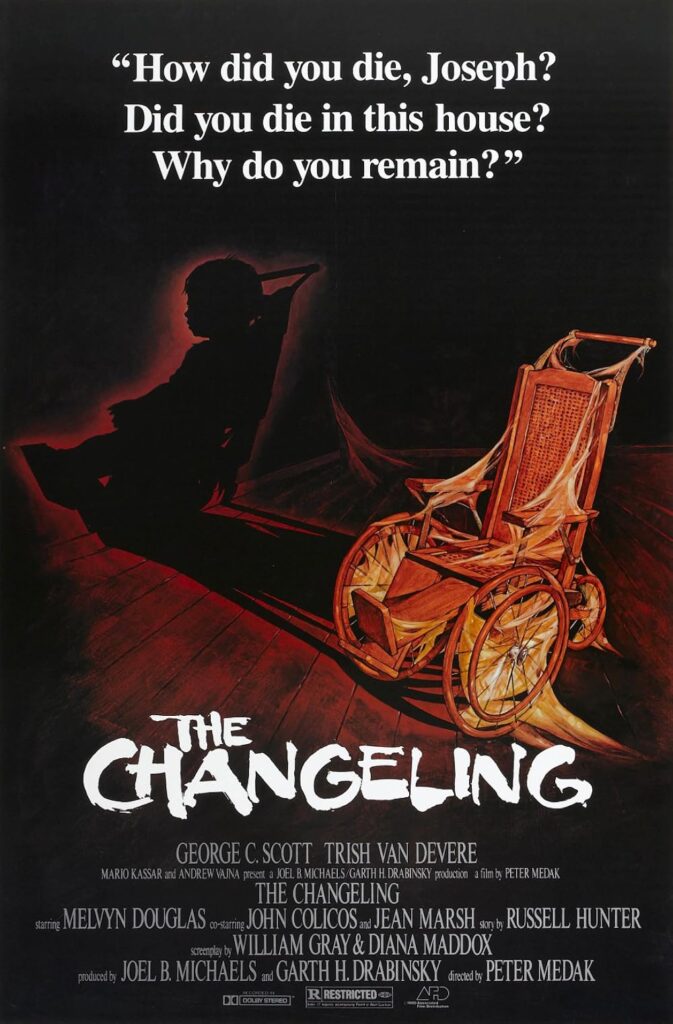
The slow, deliberate, and meditative nature of the film works because the haunting at the center of the story is so deliberately paced and feels almost tangible. The film is a series of small allowances and escalations, allowing viewers to buy into the haunting, going from innocuous coincidences and noises to direct spirit contact, culminating with a dead child’s fiery revenge from beyond the grave.
This tangibility of the haunting is presented in three key set pieces, all very frightening, though maybe less so in today’s modern horror aesthetic. But for me, personally, as one who delights in the tension of the journey, these scenes still give me a good scare to this day. These scenes focus on procedure, sound-mixing, and frequent reminders of the objects before their true, frightening payoffs.
The Ball
John Russell (George C. Scott) is a man in mourning over the tragic deaths of his wife and daughter. As he is packing up his home in New York to move to Seattle to try to move on, he has a moment where he recalls his daughter and her red rubber ball, a favorite toy. The ball, in the scene, bounces out of a box meant to be taken to Seattle. At this point, the film will return to the ball several times to remind us of its presence and a focus for grief and the haunting to come.
Hauntings in narratives are often of a double purpose. They are meant to create tension and suggest complexity in how we view death. The premise of ghosts questions finality and begs the question of a form of immortality, a desire that has haunted humanity since the first shaman existed.
Hauntings are also metaphors for trauma and grief that haunt the protagonist of the story – the haunting may at first not be related to their crisis coming into the story but becomes intertwined with it. To come to terms with what haunts them, they must also come to terms with the spiritual chaos that has engulfed their lives.
The Changeling is a perfect distillation of these two purposes in the ghost narrative form. The ball that is introduced so early into the film, part of one of the most frightening sequences of the film, is a tangible object of haunting. It becomes a hybrid object of psychological trauma for the character of John, as well as a tool to motivate him to help the ghost of Joseph Carmichael in the manor.
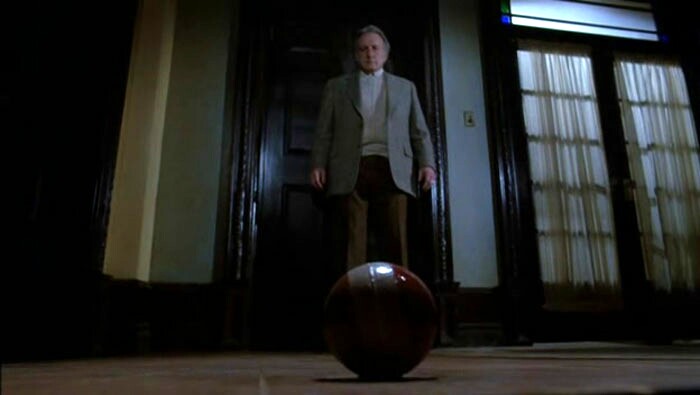
The payoff to the numerous instances of the ball is the moment Joseph, whose hauntings until this point were subtle, is now interacting with a tangible object, directly contacting John. John discovers the ball bouncing down the stairs in his foyer and then proceeds to check where he stored it – an earlier scene with Claire (Trish Van Devere) is the reminder of the ball’s importance. John is the skeptical man, a great protagonist for ghost stories. He confirms this is the same ball that, now in his hand, was not where he’d placed it in that scene with Claire.
The physicality of holding this ball, a child’s toy he knows intimately, and still checking to see if it is the ball is brilliant writing and characterization. In this moment, Joseph, the unknown ghost, has rattled John. John lies to himself in response and drives out to a river to abandon the ball to dark waters below a bridge. John is telling himself he wants to move on here, but that is too easy for the narrative. He drops it into the water, but we all know what is coming. We all know in our hearts what this story is.
Instead, he returns to the manor, enters the foyer, and watches the red rubber ball come bouncing back down the stairs, still wet from the river. John Russell has been initiated into the spiritual world, and his personal haunting is now intertwined with the spiritual haunting represented by the ghost of Joseph Carmichael. Their grief is now enjoined.
The Reel-to-Reel
Another object of importance to the effectiveness of The Changeling is John’s reel-to-reel recorder. As a composer, the man knows the technology intimately and is a steady hand with it. Much like the red rubber ball, the importance of the reel-to-reel is quickly established, and periodic reminders set it up for a shocking reveal. John utilizes it in his compositions. There is a later scene, after the discovery of a music box in the attic, where the reel-to-reel recorder appears again, revealing that the composition John has been working on is the same tune that plays from this old music box.
The subtlety of this is excellent. The ritual of using the reel-to-reel and evoking it repeatedly establishes it as an important object in John’s life and a connection to a reality that is tangible to him. The intrusion of the mysterious melody in his recorded work is one of the more direct manifestations of Joseph’s will on John’s new life in Seattle. But this is all in favor of setting up yet another frightening scene – the séance.
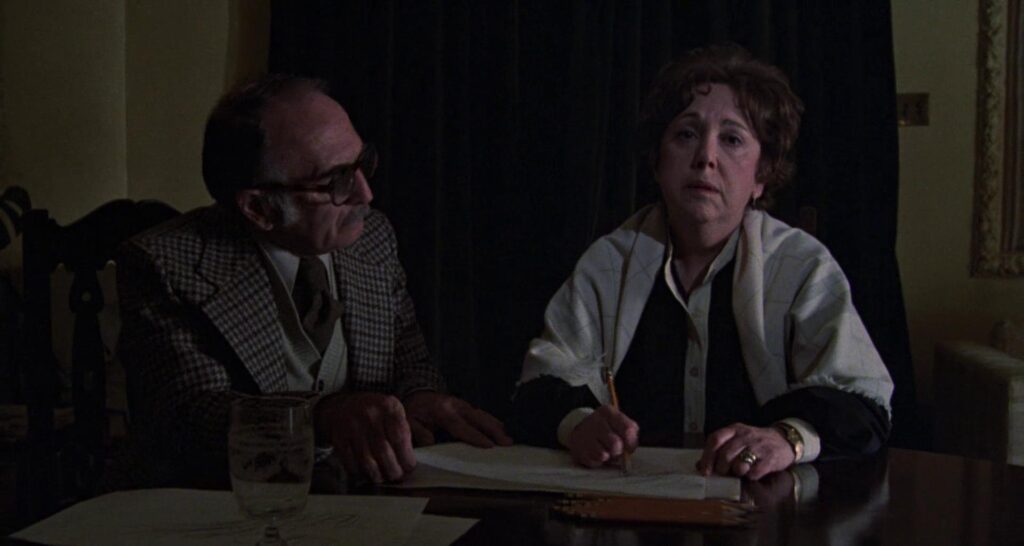
The séance scene is quite intense and one of the most effectively chilling séances put into any film. The medium, played by Helen Burns, is chilling in her intensity. As she stares at nothing, her hand hurriedly scribbles across sheets of paper as her husband tries to keep up with the flurry of automatic writing. The whole time, she asks questions of the unknown ghost, who finally makes himself known in this scene. At first, it is through the spirit writing. But the reel-to-reel looms in the scene, almost an individual, seated at the table where the séance occurs.
Following the séance, John sits alone in the room, trying to grapple with what he experienced, and nearly leaves the room before turning to the familiar tangible reel-to-reel. He puts his trust in the rational, in an object of objective reality, and here again Joseph uses this to force his will upon John, to intertwine their haunts. The playback of the séance now covers the missing half of the conversation between medium and spirit. Joseph’s ghostly voice answers every question, and John must commit to solving a mystery. The audio is wonderfully done and iconic in how creepy it is. Procedure and auditory evidence play masterfully in creating tension.
The Medal
The final object to discuss in a film filled with haunted objects is Joseph’s christening medal. The medal becomes not only a marker for John’s experiences as a tangible reality, but also a marker of societal and family trauma. Joseph, the ghost, was a sickly child murdered by a powerful father who couldn’t risk his empire on a weak child. The titular “Changeling” of the film is Senator Joseph Carmichael (Melvyn Douglas), an adopted child who replaced the murdered Joseph, inheriting an empire that is not his. His success is built on death, fear, and greed. The medal is treated as a form of proof in the narrative, but is also dismissed as easily faked as well. Instead, the medal serves as evidence specifically for the Changeling Joseph – Ghost Joseph seeks acknowledgement of his replacement’s inherited sins.
The medal is mostly introduced through Ghost Joseph’s wailing and seen in a vision of the horrific murder. The medal only becomes real when John – searching for Joseph’s corpse in an abandoned well, paved over for the sake of progress as a parcel of the estate – is presented with the medal by the ghost. The scene depicting the medal rising from the soil is a trick of reverse photography, with a chilling and unnatural feeling, much like the situation.
Of course, the medal is the third object in this mystery to force John to walk into the spiritual world, and he keeps it on him. He tries to confront the senator about this murder, with the evidence in hand. A police detective comes to get the medal and is killed by the ghost of Joseph in a freak accident as the ghost grows more hostile. The Ghost of Joseph is so close to a resolution that he lashes out at each delay. John feels exhausted and trapped. And soon, Senator Joseph Carmichael must confront the presence of a second christening medal, indelible proof of the events – his medal being a duplicate.
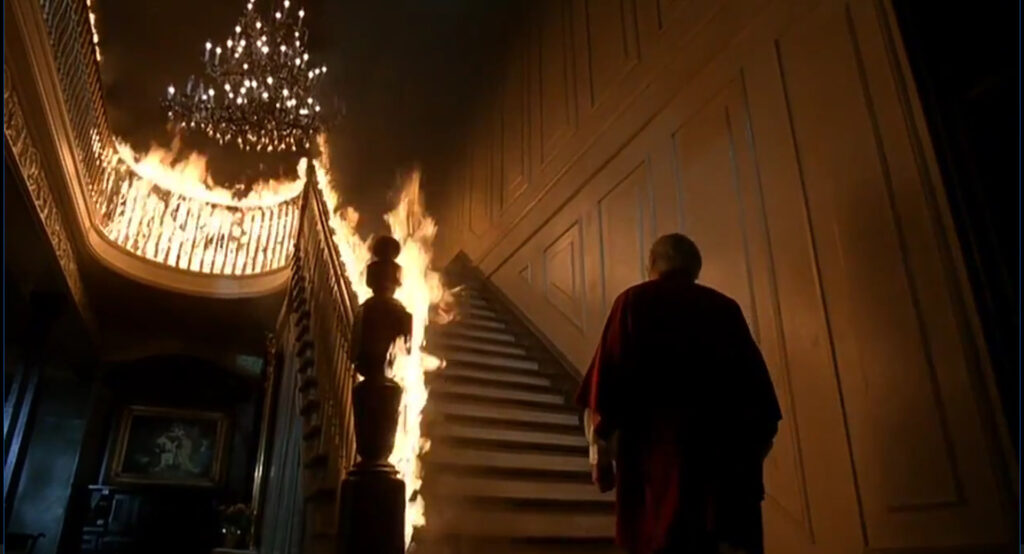
In the film’s fiery climax, after John gets a meeting with the senator and lays out everything, the senator finally acknowledges the truth of his situation – he is a changeling, and his life has been a lie to maintain a father’s greed. In this moment, his spirit, channeled through Joseph’s will and the medal, is seen by John as the mansion burns down around him. Senator Carmichael’s manifestation climbs the stairs to the attic bedroom of the child he replaced and witnesses the horror of his father’s crime. The senator dies back in his own senatorial home, miles away, of a heart attack. Ghost Joseph has had his revenge and lets the mansion burn.
Trauma Never Vanishes, You Just Get Used to It
But what of the haunting itself? The film suggests maybe that Joseph is not done. We see John escape the mourning mansion with Claire but see him later at the Senator’s home, exhausted, looking on as the man’s body is wheeled out. The final moment of the film shows the music box in the burned wreckage. It opens and begins to play that haunting melody all on its own.
The film’s ending, as I see it, is dark. There is no real catharsis present – the changeling is a victim in all of this, too. John Russell will never be able to heal entirely from his loss, and Joseph, a scorned and vengeful child, has seen to that. John is strangely somewhat culpable for the senator’s death and will carry that burden, as it is now entwined with his own loss. Much like how a composer uses instruments as tools to manifest art, John is a tool to manifest revenge. Another tragedy for the psyche to endure. His life is forever altered by a spirit from 1909, and in the ashes of the burned manor, another haunted object awaits the unwitting. The trauma does not vanish but merely changes hands.
This has been an installment of Graphic Content; support my writing by joining me on Ko-fi.

This movie was so good. It had tremendous pacing. The slowness of it helped sell the horror for me. That damn ball is gonna be in my dreams. Another item is the wheel chair. That shit got to me. Thanks again for sharing the movie with us it was a fantastic time. :3 💚😘
[…] we are onto essay #7, which is about 1978’s Halloween! Be sure to catch #6 if you have not read […]