



Welcome back; we have a new post for 31 Days of Halloween, and we’ve now wrapped up the second timeline of Halloween films with Halloween: Resurrection (2002). Only six more movies and two more timelines to go!
How have you been enjoying the posts so far? I know the focus on the Michael Myers films has probably been a lot, but this is something I’ve wanted to do for quite a while. We’ll be moving into some other movies before the month is through.
I’m surprised I have managed to write as much or as lucidly about the bulk of this franchise, since I just don’t really like all of these movies. They’re fun, but we’re running through movies I’ve seen two or three times and never really felt a desire to revisit more than that. I feel a little bit like I am phoning things in just because I’m not entirely compelled by the movies, but I do think I have been able to find some decent angles to them, at least.
Of course, your mileage may vary. Happy reading.
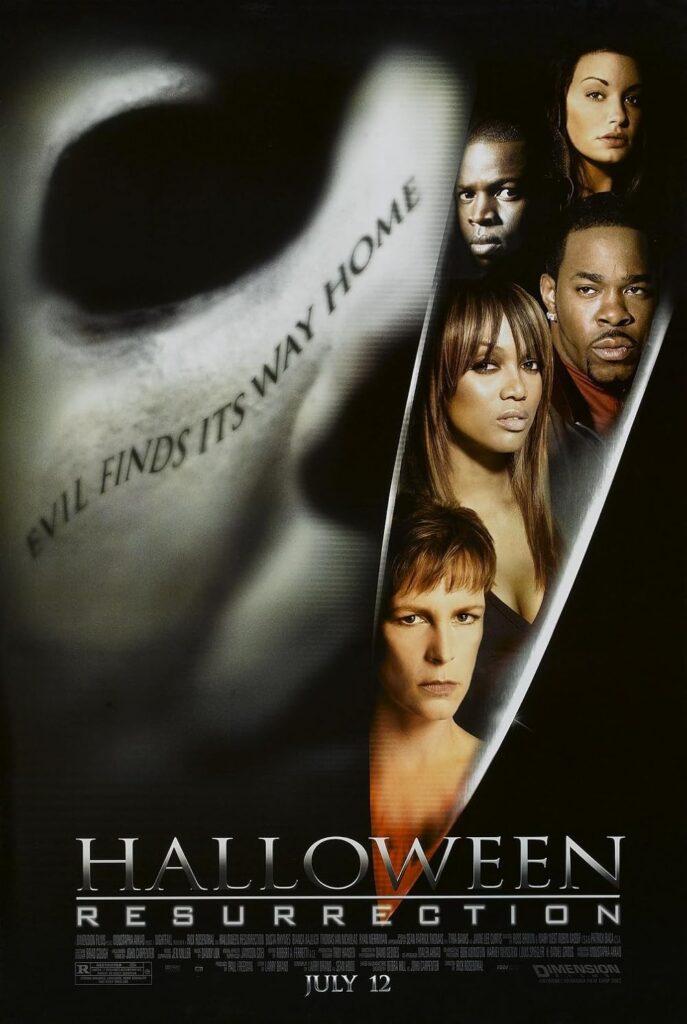
Here again we reach another milestone for Halloween, or more to the point, a grave marker, because the legacy series ends with the second film following Halloween H20: 20 Years Later (1998), Halloween: Resurrection (2002). We’ll be moving into Rob Zombie’s two films next.
As for Halloween: Resurrection, it places Michael Myers firmly in the culture of the early internet, and there is some real potential there. The problem is the film is largely a mess of half-measures and two very different stories duct-taped together to clean up a messy continuity and get one more “It’s Laurie!” for the marketing team.
The film makes a bold decision to awkwardly end Laurie’s story, despite the relative tidiness of H20’s ending. Jamie Lee Curtis wanted out, but there was the nagging issue of Michael being dead. The solution ended up having Laurie end up beheading an entirely different person at the end of H20, creating an awkwardly stitched-together flashback revealing Michael swapped his clothes and mask with an innocent man – meaning that Laurie actually decapitated a father of three.
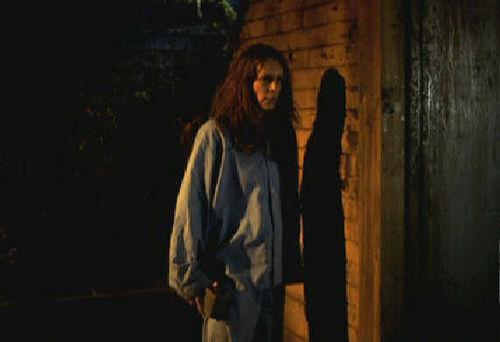
It’s a disrespectful and ridiculous way to contrive Michael’s survival at the cost of an iconic character in Laurie. A cultish magical ritual is a more desirable explanation than that. Even worse, this contrivance culminates in the death of Laurie in the first fifteen minutes of the movie, stripping the character of agency. There is a feeble pass by the writers to give Laurie, a now hardened survivor, the upper hand, only to immediately cut her legs out from under her because she hesitates, terrified she is about to execute another man. The film does nothing with any of this; Michael hands his knife to a mental patient, a symbolic passing of the torch into retirement, and the movie draws no larger meaning from any of it, as an entire second film starts there. The real horror is how cheap it all feels.
Removing the opening act would change nothing about the rest of the film. It’s pointless, dismissive, and has the stink of producers’ negotiations all over it. Most of these Halloween films are not high art, but they largely try to tell cohesive stories driven by a central concept. Resurrection may be the most cynical opening to a film I have ever seen in its nakedly market-driven approach about how to squeeze a little bit of the original juice into this film.
This opening is even more disappointing because the remainder of the Strode-less narrative has a generally strong, modernized concept. As happens with a great many of these films, though, the execution tends to be lacking.
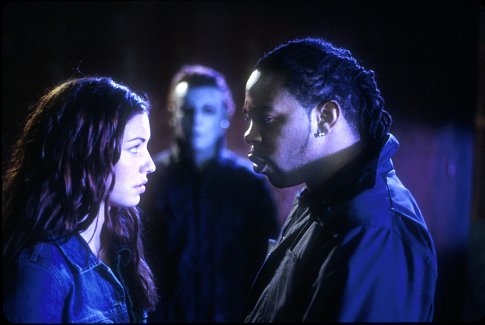
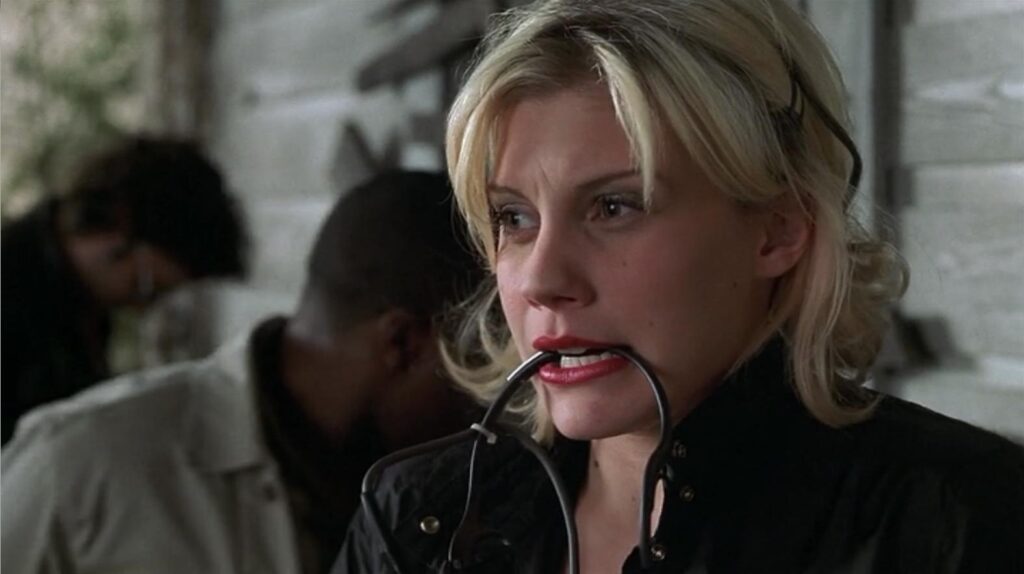
I don’t think Rick Rosenthal, returning from Halloween II to direct Resurrection, really understood the internet enough to lean into the concept of the film. The concept itself is strong: a group of participants is tasked with “investigating” the Myers house for an internet reality show. We could have a very interesting story that examines internet culture, reality content, and modern memification of tragedy, but the film doesn’t really lean into it, either. The use of the webcams works, but the film uses them as a stylish afterthought as opposed to the core way in which the story is told.
Thinking back to John Carpenter’s Halloween and Dean Cundey’s predatory camera, the found-footage approach feels like such a good evolution of the original film, if it were to be embraced. In the original, we often looked through the limited view of Michael Myers, seeing where he lurked, out of sight. Now imagine a film utilizing the locked viewpoints of cameras with no authorial eye or frame that doesn’t come from within the world and characters themselves. Imagine seeing Michael just out of frame in a moment of innocuous conversation between two characters, or how supernaturally fast and disorienting he would be, because we only see him appear through a limited set of points of view. Have Michael pop up when least expected, always watching.
That’s not even considering the “live” element of the broadcast. While Halloween: Resurrection has some fun with the observers watching events play out, one might wonder how much better that might be handled today and leveraging the tropes and apps of live events we see in film these days. As much as I cringe at TikTok, seeing people reacting in horror through the verisimilitude of the platform does carry its own appeal. Get someone who “gets” the internet and larger culture surrounding it, give them a few cheap cameras and some props, and I think you may really have something there.
Halloween: Resurrection has plenty of problems, but I don’t think the streaming angle is one of them. I think it is time to give it another shot. After Halloween Ends we’re going to need to reboot again anyway, right?
This has been an installment of Graphic Content; support my writing by joining me on Ko-fi.
