



I really had to struggle writing today’s piece for 31 Days of Halloween on The Invisible Man (1933). This was not due to a lack of interest, as I love the movie. It is more due to a massive migraine. My sensitivity to light really hit me hard today, and writing and staring at a big monitor certainly do not help when that happens.
But I struggled through it and wrote this piece before the clock rolled over on day 12. Whether this one is a success will be up to you to determine. So please, let me know what you think. Happy hauntings, everyone.
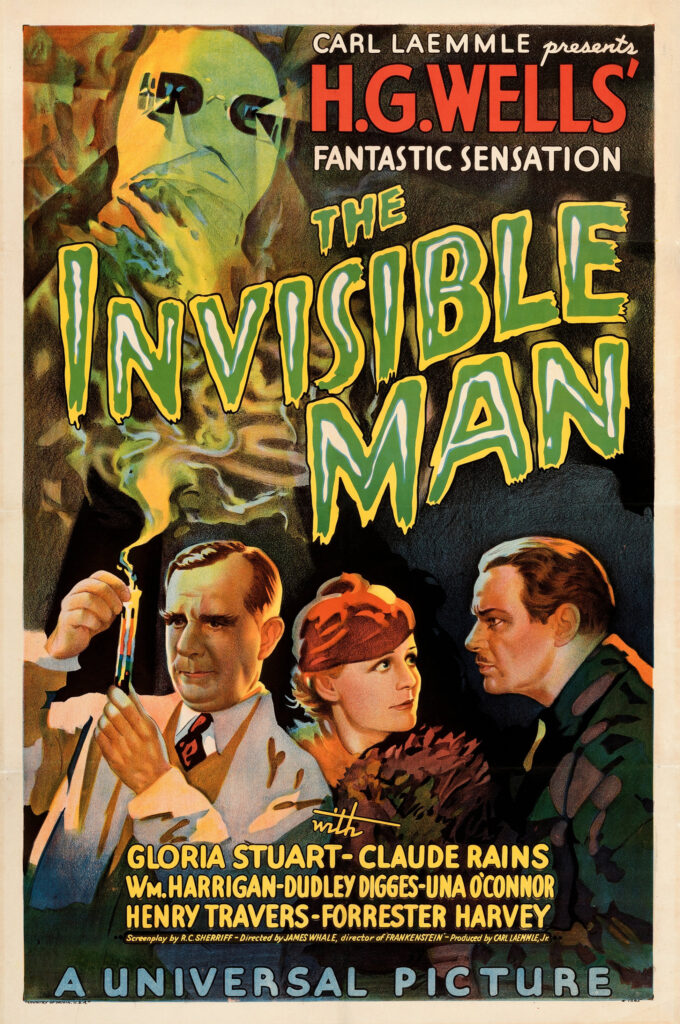
The house that Dracula built is responsible for the original filmic depictions of some of the most iconic monster characters to ever exist. These monsters frightened in their time and persist to this day, though due to changing tastes over a century, they may not have the horrific power they once did. More than likely, a more modern audience may find themselves finding empathy for figures like the Wolf-man, Dracula, Frankenstein, and the Gillman. But one monster introduced early into this streak of incredible Universal Monster films, The Invisible Man, may be the most frightening of all – even today. Jack Griffin, the monstrous protagonist of James Whale’s 1933 adaptation of H.G. Wells’ 1897 novel, is by far the most monstrous of the Universal Monsters because he is just a human who demonstrates an incredible level of inhumanity that evokes the evil humans are capable of in real life, and what would be seen in the decade following the film’s release as World War II broke out.
Invisibility is a Terrifying Power
Have you ever played an icebreaker game where you ask people what superpower or ability they most want? If anyone answers invisibility, side-eye them immediately. I am going to say something controversial here: invisibility is the desired power of the fearful or the power-hungry. As a society, we derive order through scrutiny – the Greeks made that inescapably clear through Plato’s The Republic. The story of the Ring of Gyges is a proto-ancestor to the Universal film. A shepherd finds a ring that grants invisibility and proceeds to seduce a queen, murder a king, and seize the throne. As Glaucon states, a just and unjust man alike will fall to the temptation of doing evil if it brings profit through a lack of direct observation.
Even in the most optimistic outcome, for someone who is an outsider who seeks invisibility to escape the gaze of a cruel world, the temptation is there. Being an outsider can be hell, but freedom from consequences, when not deliberately sought out, can be corrosive to the soul. The One Ring in The Lord of the Rings illustrates this, where even the good soul of Frodo falls thrall to the ring before he is ultimately freed from it by the violent struggle with the corrupt Gollum.
In any case, in most scenarios, a wish for invisibility is reflective of an inner pursuit of power or freedom to commit selfish deeds. Even the fear of being an outsider and wishing to escape the cruel gaze of a world that does not understand us by literalizing one’s invisibility is still born of selfishness and can lead to corruption. The uncorruptible are meant to fight – to deny the world their struggles for justice is to be inherently selfish.
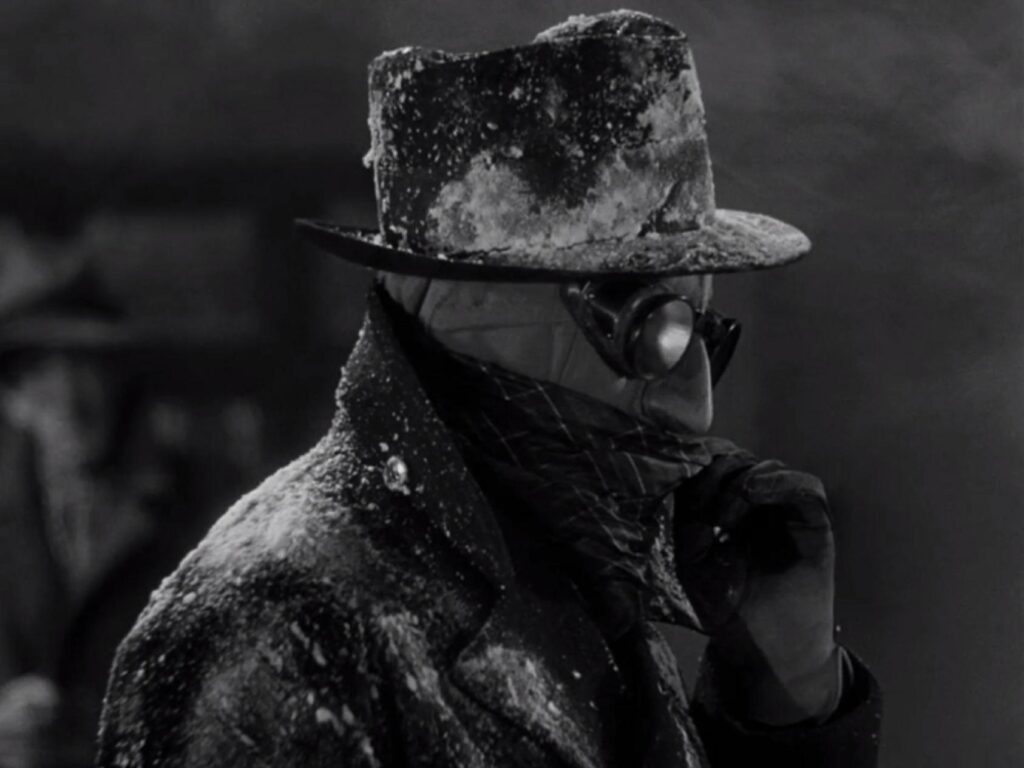
Invisible Man: Ghoulish Glee
The Jack Griffin of Whale’s The Invisible Man is Plato’s shepherd, a man who seeks freedom for selfish pursuit and will commit unjust deeds because they are an easier path. He is free from consequences for most of the film, though not ultimately, due to his inability to be observed.
Jack Griffin’s power as a monster, despite being a mere mortal (the invisibility does not change his inherent nature as a human being with a frail and finite existence) owes everything to Claude Rains’ performance and characterization of Jack. The challenge of acting invisible, or at best, emoting through layers of gauze, resulted in bold choices by Rains to characterize his version of Griffin. Rains’ best asset here is his voice and laughter, which deliver the cruelty and madness of Griffin’s character. Seeing a pair of pants or a dress shirt flying around a space with no visible body to wear it, paired with Rains’ laughter, still feels chilling. It is especially affecting when considering the actions that Griffin undertakes while in partial or complete invisibility, ranging from cruel murder to childish, immature pranks. Griffin is having the time of his life while committing some incredibly awful actions, and Rains’ laughter provides a percussive reminder of the madness underlying the man.
The Two Jacks
The film adaptation of The Invisible Man departs significantly from H.G. Wells’ book. Neither Jack is particularly sympathetic, and both are essentially antisocial monsters. Wells’ Jack is an albino misanthrope who has been rejected by the world and embittered. To a degree, this garners some empathy for the character and, while not justifying his actions, makes his situation understandable.
The Jack written in R.C. Sherriff’s script adaptation applies a more romanticized characterization to the protagonist in what in many ways feels like an adjustment for the weaknesses of Whale’s 1931 Frankenstein adaptation. Forced to give the film a happy ending by the studio, Henry’s fate does not feel like Whale’s voice that would be seen in other films. In The Invisible Man, the romantic scientist does not get a happy ending, fitting the nature of the evil he commits. The film suggests that maybe the drug that creates his invisibility is laced with a chemical known as “monocaine,” resulting in his narcissistic and murderous behavior. Supposedly, a chemical eats the mind – but I feel his mind was rotten to begin with. His contemptuous and bullying behavior toward Kemp, his unfortunate accomplice, feels too deep-seated to be a result of the experiment. All the drug grants Griffin is his freedom from restraint – his id unleashed.
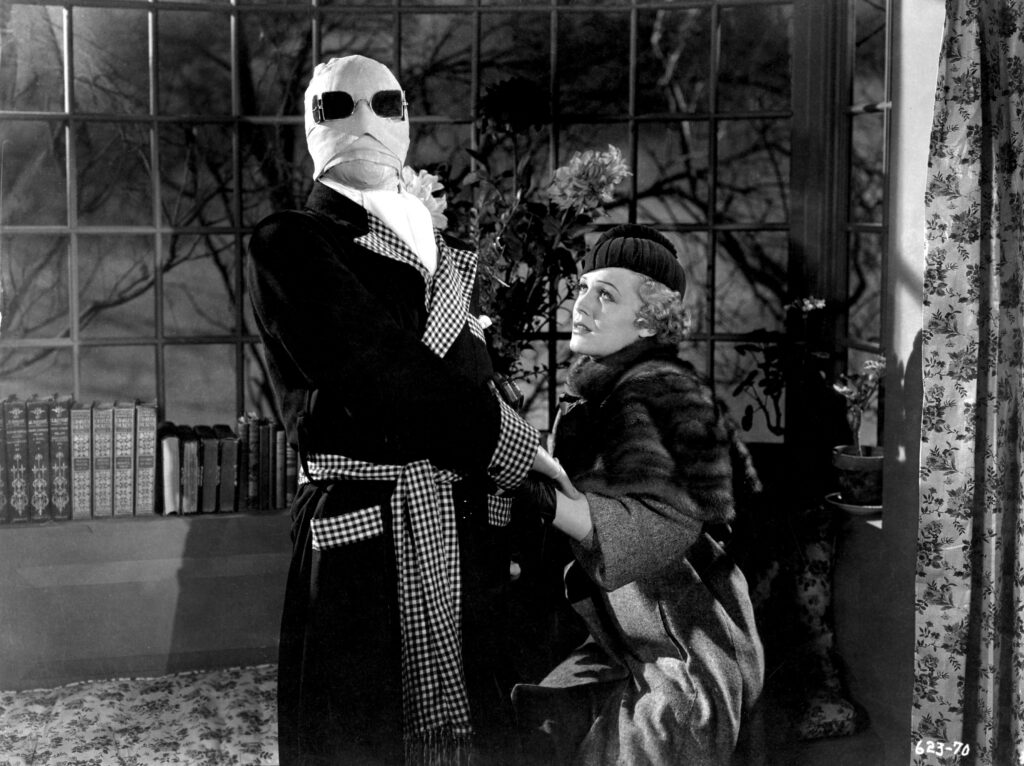
What we get of the pre-visibility-challenged existence of Griffin from the narrative is a man who has everything: steady work, respect, a fiancée, but we also get Kemp, the romantic rival for Flora, convinced something is rotten with Griffin, noting his secrecy before his disappearance (both literal and metaphorical). Kemp’s murder is extremely cruel – it turns out he was right, honestly. That probably provided little comfort as the flaming wreckage of his car tumbles down a cliff, however.
Jack’s Crimes and Control
Jack’s crimes are rather fascinating to consider in the film. Even though the man is invisible, he is still a man, and the chaos he causes is tremendous. He commits around 123 murders in the film, including 20 men in a search party trying to seek him out and derailing a train with 100 passengers and crew. He also commits assault and battery several times, whether they have committed any perceived slight to him or not. His lab partner, Kemp, is essentially kidnapped and imprisoned by Griffin. Further, Griffin is a terrorist, destroying property, raiding financial institutions to redistribute wealth out of spite rather than some Robin Hood-fantasy altruism, and, again, destroying railroad infrastructure. The countryside is terrified and paranoid of this invisible menace.
While I am less motivated to condemn the anti-government action Griffin engages in because government institutions are inherently untrustworthy, his motivations are entirely fascist, where the problem really lies. Griffin’s megalomania and belief in his superiority motivate his actions in pursuit of personal power. In fact, when he reveals himself to Kemp, that is part of his pitch to Kemp as he strong-arms the man. Kemp should be the right hand of the devil rather than be under his foot.

Jack Griffin is given tremendous power, and there is no sign he ever considered the greater good upon receiving it. His motivation for his experiments? Personal glory, to be the man who did it. And as for Flora, the woman meant to humanize Jack in the screenplay, it is telling that his last thoughts as he dies are of her. I don’t see it as love, but rather greed. She tried her best to save and support him during these events, and Jack spurned the help because he “knew better.” Even in his defeat, he exercises and maintains control, pulling Flora back in because he controls her and knows it. Even in his dying, he exerts control and inflicts his will, hungry to maintain a sense of power to his last breath.
As Griffin finally dies, The Invisible Man becomes visible; Claude Rains’ handsome face materializes. The face of the fascist madman, indistinguishable from countless other faces. Unlike his other Universal Monster contemporaries, he is not supernatural, nor folkloric; nor is he pitiable like some of his fellow monsters. He is the educated man, granted power and takes it to the logical end that mortal tyrants face. One monster dies in the film; in the real world of 1933, another rises – a seemingly normal man granted power who would go on to commit crimes at a systemic level in Germany. His crimes would not be localized to 20 square miles of British countryside, but rather drag the world into darkness and sin. Jack Griffin sought invisibility to be who he was – a monster. But his actions evoke the rise of another monster who sought visibility. Are Griffin and Hitler similar? I’d argue they are not dissimilar, making The Invisible Man feel almost prophetic to a degree. But while Griffin is a sneaky coward with totalitarian machinations, Hitler needn’t bother – having nothing to hide.
This has been an installment of Graphic Content; support my writing by joining me on Ko-fi.

You may have had trouble writing this one because of the migraine, but i sure as heck didn’t have issues reading it. I’ve actually had the pleasure to watch the Invisible Man. And yeah he was a monster. Just the idea of a person like that puts fear into me.