



Here we are with a new, second installment of the 31 Days of Halloween Vol. II, and I am already suffering a bit. I have a nasty headache and am pretty tired from a long evening at Knotts Scary Farm. It’s hard to write this stuff when you’re feeling off your game, unlike my previous post.
But the show must go on. Just be gentle with me this time around, okay?
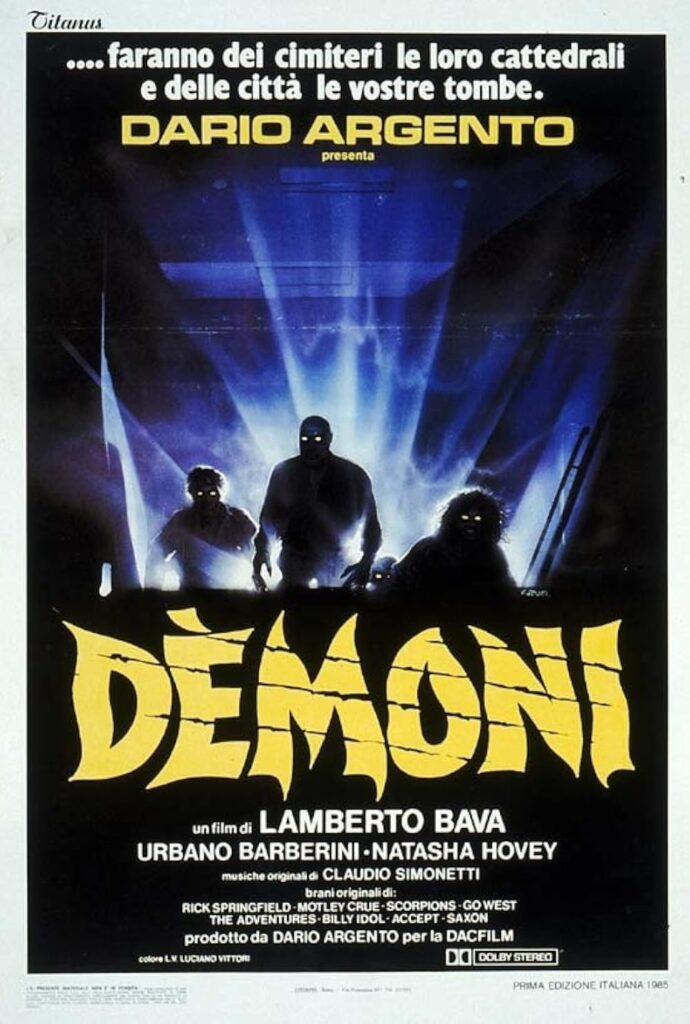
There is a lot of stuff that came to mind when rewatching Demons (1985). This is probably my fourth time seeing it. A lot of what came up were questions.
For example, why is the movie theater’s wall made of peanut brittle? Why is the only employee dressed like a Christmas elf? Why is Tony the Pimp the best character? And also, why does the helicopter have a grappling hook and launcher on board?
Most importantly… are the titular demons actually just Deadites?
The first answer to all of these questions, and more, is that this is an Italian film. IF we want to put a little extra clarification in there, it is a Dario Argento-produced Italian film. If you know, if you don’t, I do want to talk about these two ideas: Italian film and Dario Argento, which are frequently associated in my mind with dream logic.
There is actually so much I wanted to write about this film, but to maintain my 31 Days of Halloween pace, I’ll also need to briefly mention my obsession with the character Tony the Pimp. Maybe this can be something to come back to for a 31 Days of Halloween Vol. III?
Dear God, I need help. Already thinking about doing this all over again.
Anyway, on to Demons (1985).
In Search of a Point of Entry
One of the concepts I had considered before settling on what I am going to write today is the strange nature of the characters in the film. Strange in the sense that they are not so much characters with arcs, but rather action figures meant to be kept in the events of the story to be used for whatever gory set piece Lamberto Bava, Dardando Sacchetti, and Dario Argento are capable of whipping up.
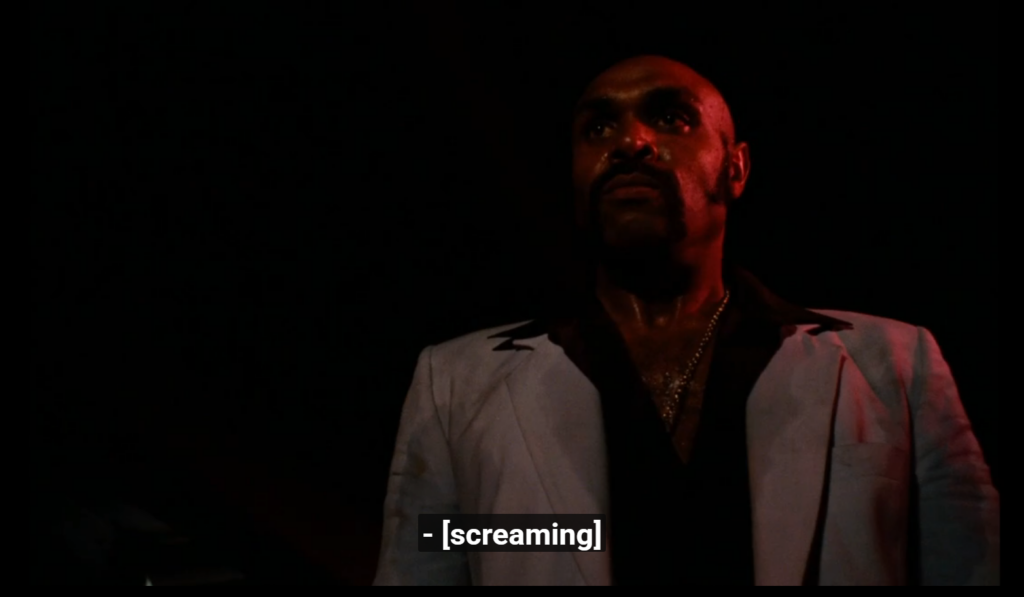
However, one character emerges to prominence, not through a compelling story, but through sheer presence. That, of course, is the character of Tony the Pimp, played by Bobby Rhodes. The actor imbues this rather flat character with such a presence you can’t help but be entertained. The movie also loses something when Tony is killed off – Urbano Barberini’s George is about as thrilling as a dinner roll, and Natasha Hovey’s Cheryl might as well just be a cardboard cutout with nothing to actually do in the film. Rhodes continues to portray the demon-zombie Tony, of course, chewing scenery along with scores of victims as a spotlight demon-zombie in several scenes.
A character so big and making so little sense, he is perfect – like out of the most badass dream you’ve ever had. How this stereotypical American pimp and his two employees gets wrangled into the events of Demons make no sense, but you just buy into it.
Legitimately, one of my first ideas when it came to deciding what to write about regarding Demons was a Crackedesque shitpost about the excellence that is Tony the Pimp. However, part of that standout success for Tony the Pimp, I think, gets to a much more significant element of the film – the Italian dream logic.
Dream Logic
Tony the Pimp is such a striking element of the story of Demons that he becomes one of the most memorable things – the edges around the film become fuzzy, but he is remembered with such vibrancy that he is an indelible image associated with the film.
If you don’t dream very often, this may be a bit hard to take at face value. But dream logic functions well enough to get you through an abstract narrative as you are dreaming, but they don’t really hold up as details when you try to recount them; most often you find yourself focusing on the stuff that just doesn’t make sense, and that is what you pull from these dreamlike scenarios.
Case in point: I had a dream once that my old dog, Toby, was driving a car, trying to come with the family on a day trip. The whole premise of the dream is that we left him at home and piled into a truck. He did not like that, grabbed one of the other cars, and followed us onto the freeway, whereupon I freaked out because Toby was not supposed to drive on freeways – he’s just not allowed.
The next morning I woke up cross with my stepfather because I was so mad that Toby was driving a car on the freeway. It felt convincing enough. None of it makes sense, but that detail about Toby driving on the freeway – something he was forbidden to do in the context of the dream- was what I pulled most readily from the whole surreal narrative that emerged from my head.
A lot of Italian horror is like that, for me. There is a loose narrative to string together events, but I can’t help but get hung up on the details that don’t make sense in a sea of things that do not make sense. Why is the only employee of the theater dressed like a Christmas elf? Why did the blind man go to a movie? Why are two of the punks’ names Baby Pig and Hot Dog? Why does a helicopter that crashed through the roof of the theater have a grappling hook and launcher, which is exactly what is needed to escape the theater?
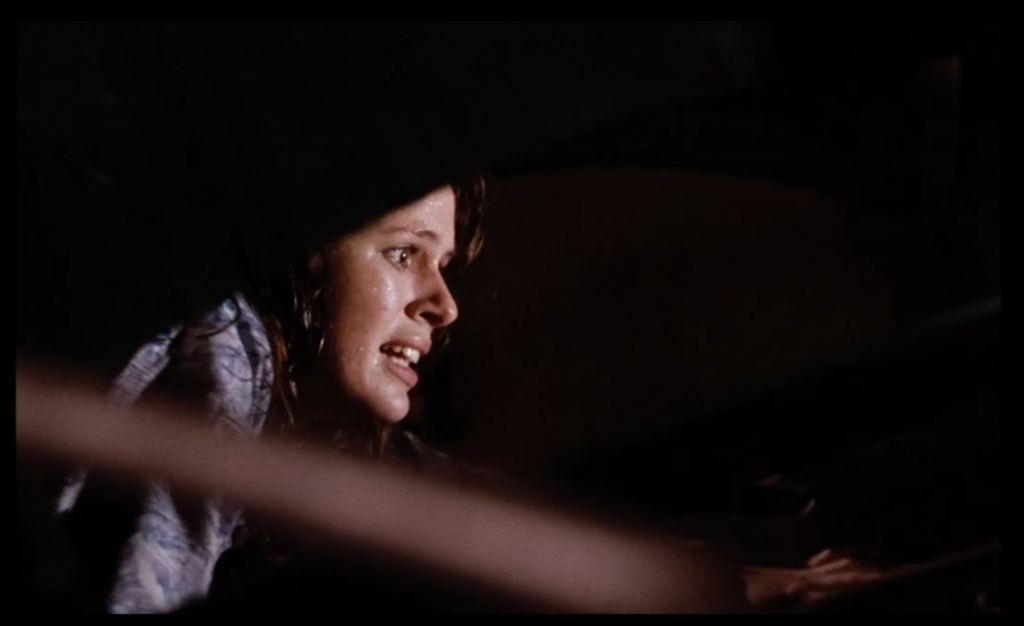
This isn’t about overthinking these things – we accept them and run with them during the duration of the movie to move us from one gory moment to the next. But they do stand out – like my dog driving on the freeway.
I made a particular note about the involvement of Dario Argento in this film: many of his films are like this, where dream logic pervades, and we are lulled into the film and just accept it. The strange thing exists because it must for the movie to work. Suspiria (1977) is a fantastic example of just this kind of thing. Why does the dance academy have a room full of barbed wire? Because it has too much in the moment. Why do all the doors feel so much bigger than they should? Because it puts us in a weird headspace for the rest of the events in the film.
It’s all a dreamlike structure meant to serve an aesthetic. Even if we can point it out, is there ultimately any real harm in that? If we wanted true coherence, we wouldn’t be watching a 1980s Italian horror film. That is why I found so much and so little to discuss here, because analyzing dream logic is ultimately more of an exercise in understanding what is going on in one’s own head than any greater insight into the film.
Or maybe, as I write all of this, I realize that the film is something better experienced than read about. Maybe the point here is an exercise of sorts – give in to the movie and see what oddities stand out to you. What do you make of them? I question the grappling hook, but I can logic my way into accepting its existence, and the movie is just fine. What sticks in your craw?
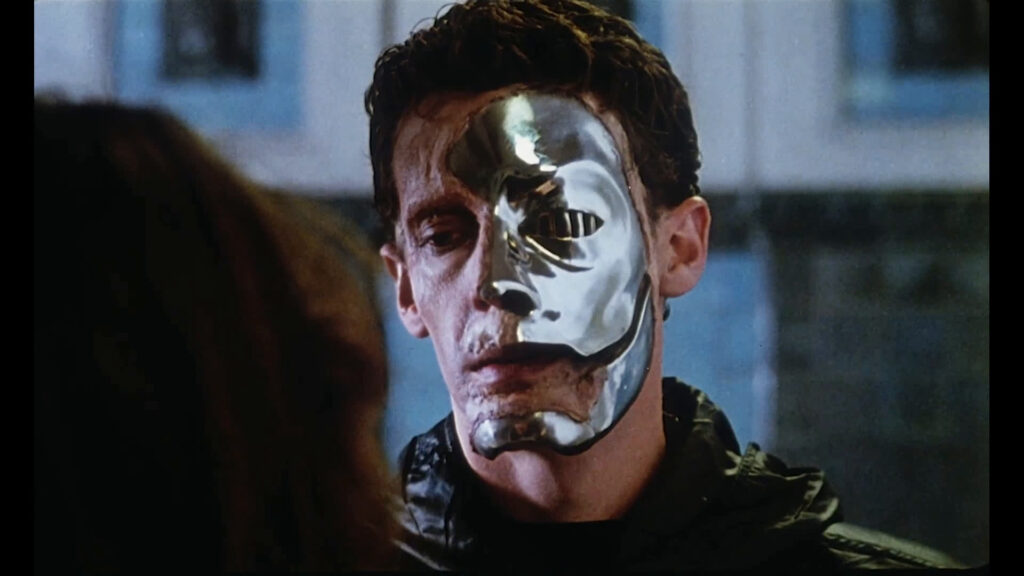
I haven’t even written a damn thing about the guy with the tinfoil mask or the prop mask in the theater that kicks off the whole demon invasion that results in the apocalypse. There is that much going on in the wonderful, strange movie. It’s a labyrinth of weird and you can become fixated on even the smallest of frictions far too easily.
So Are They Deadites?
One final thought I wanted to raise before moving on: are the Demons from this movie Deadites? Obviously they are not, as there is no official production crossover here, but their characterization, aesthetic, and vicious streak certainly remind me of Sam Raimi’s iconic undead bastards. However, this movie has a certain whack-a-doo gore aesthetic that feels cribbed from The Evil Dead, which predates this one by a couple of years. It’s not too outlandish to think there may be a little influence here.
What do you think?
This has been an installment of Graphic Content; support my writing by joining me on Ko-fi.

[…] there isn’t a lot going for The Last Man on Earth. Of course, as I covered a little bit of Italian dream logic yesterday, we get a solid dose of that in The Last Man on Earth as well, given it is an American/Italian […]
[…] For today’s 31 Days of Halloween Vol. II, I wrote about the new release, Other Mommy. Well, more accurately, I ended up drifting into thoughts of Evil Dead, but that’s most days for me. The central question, “Will it Deadite?” will make more sense if you read along. I am starting to develop a little bit of a Deadite through-line this month, thanks to Other Mommy and Demons (1985). […]