


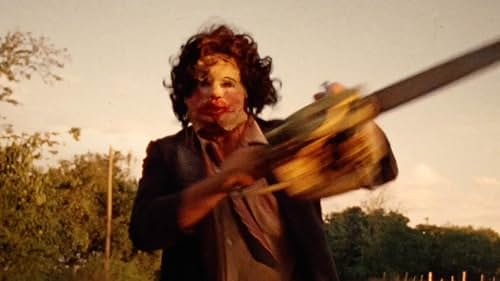
For today’s essay for 31 Days of Halloween Vol. II, I return to the well that is The Texas Chainsaw Massacre (1974). This won’t be the last time I write about this movie. In fact, I am seeing this piece today as a foundation for a potentially larger essay in the future. But we’ll see how that goes.
Anyway, onto some thoughts about Tobe Hooper’s classic.
Before that, why not check out a poem about the movie?
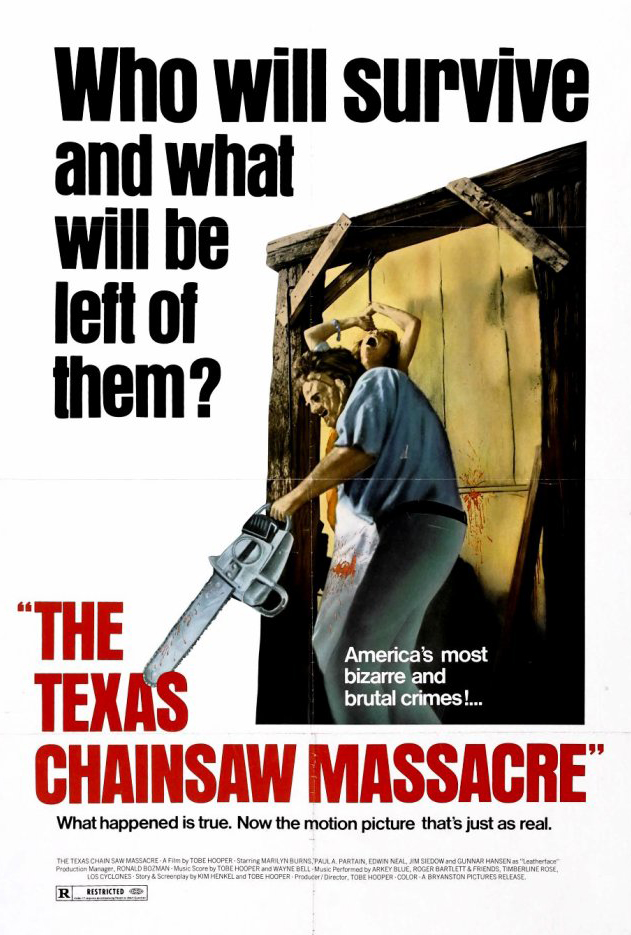
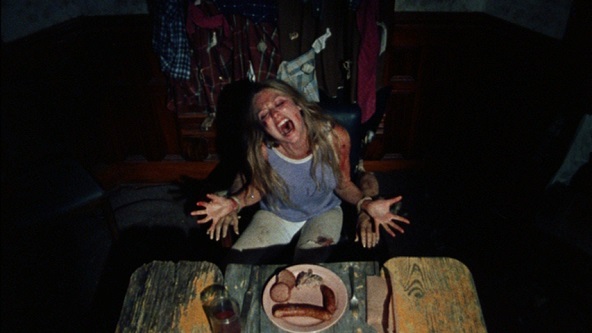
Today was my first time ever seeing Tobe Hooper’s The Texas Chainsaw Massacre (1974) on the big screen, after having watched it dozens of times over three decades. Maybe far too many times. I am not sure how healthy multiple rewatches a year can be. The screening was a promotion between Regal Cinemas and Fangoria, and I am thankful it existed to give me the chance to experience the film as closely in form to the original theatrical release as possible. I even bought a hot dog for my human BBQ movie. It was delicious.
Every time I watch the movie, I find some angle to focus on. Last time I covered it in the previous 31 Days of Halloween project, I focused on the chaotic energy of the opening. This is the American fever dream of horror that so captures the 20th-century American transition from the post-WWII high to the defeat and cynicism of Vietnam and mass violence, paranoia, and systemic betrayal at home.
This time around, though, I found myself preoccupied with the occult and ritualistic imagery presented in the film, and I began to worry I was overthinking things. Being an occult podcaster (check out Supernatural Selection if you haven’t heard it before), it becomes easy to fall into seeing signs and overthinking when you are so steeped in research, lore, and the patterns of magical thinking. You become entangled in the mixing of aesthetic symbolism and esoteric thinking that can represent the metaphysical. As the credits rolled, I pulled the thread of my thinking and worried that I had fallen into another “woo-woo” hole, as we so often do on the podcast.
But I am happy to know I’m not alone here either. Plenty have written about the occult and ritualistic vibes present in the film. One of the things I love so much about the original film, and appreciate in the later entries, is a lack of the supernatural, where it becomes too easy for a franchise to embrace the “woo-woo.” And barring Matthew McConaughey’s robot legs in The Texas Chainsaw Massacre: The Next Generation (1995), there isn’t that much weirdness in the continuing exploits of the cannibalistic Sawyer family.
That is not to say there isn’t enough in the original film to support a more supernatural reading. But I like that in the original Massacre, it is all subtext – evidence of backwoods cannibal magical thinking. Isolation does strange things to people. It made the Sawyers cannibals, obviously, but it also creates strange, homebrew religions, too.
Backwoods Magic
The freedom of faith in America is often thrown into doubt, and what might be considered our more “civilized” spaces can be read as freedom of specific faiths. But just as America became an escape for religious practice outside of the dominant hegemony of the lands of those who fled to new shores, the isolation, hills, and woods of the frontier gave birth to new ways of thinking for isolated folk. Perhaps the most famous backwoods faith we have today in the U.S. is Pentecostalism, but it is far from the only one, and a great deal of horror films derive fright from depictions of witchy, sinister folk magic that flies far outside the norm of the “respectable.” That is not to besmirch witchcraft and folk beliefs; however, I am just writing in broad terms from an ideological perspective that is based on the center, not the outsiders (it isn’t even my position, either). It’s all highly problematic thinking, but it sets the tone. It’s good fodder for the imagination.
In The Texas Chainsaw Massacre, there are three distinct ritualistic and occult images I keep returning to when I think about all of this. In a film about a brood of former slaughterhouse workers who start making human BBQ to make ends meet, it doesn’t seem too great a stretch to see these images, consider the clichés and tropes of backwoods religion, and see something deeper going on.
Malefic Planets and Things Beyond Control
The astrological framing of The Texas Chainsaw Massacre strikes a tone early. In what is meant to be dialogue to convey the character of Pam (Teri McMinn), discussing astrological symbolism, it becomes a hint at the more otherworldly experience that will play out over the course of the film. Mostly played for humor, it becomes a warning when, following a rough encounter with the Hitchhiker (Edwin Neal), Pam discusses Franklin’s (Paul Partain) experience in the context of planetary alignments. Prior to their encounter with the Hitchhiker, she reads: “You see, Saturn’s in retrograde, and malefic planets like Saturn… their influence is cold, and dry, and sinister. And right now they’re exerting an immense power over you, and you can’t even see it.”
The word “malefic” is an interesting one, as it is a word often associated with witchcraft – at least in the context of witchcraft being seen as evil and harmful. This malefic presence promises changes and strange and unexpected happenings.
When they kick the Hitchhiker out, she then follows up with this gem of a quote: “Things happen here about you, and you find out later what was the reason for them. But at the time you’re involved, you don’t know anything about it.”
A viewer can see the prophetic element in this, but astrology also tends to use language to broaden such predictions and warnings to apply to as many people as possible. Regardless, it does establish there is something supernaturally tinged within the film if one chooses to fall into it.
I want to draw attention to Nat Brehmer’s post on occult elements in The Texas Chainsaw Massacre, as they point out the trope of the harbinger is occupied by Pam and her astrological thinking, rather than what we would more traditionally assume is the man speaking spooky warnings in the graveyard. Quoting Brehmer here: “Of course, the role of the harbinger of doom truly belongs to Pam’s fascination with astrology. As she reads off their horoscopes, she inadvertently reveals The Texas Chain Saw Massacre as a work in cosmic horror in which the fate of our characters is literally written in the stars.”
This astrological angle is not something just thrown in, Hooper and Henkel wrote it in for a reason. Whether that reason is to tie the horror to a more supernatural experience comes down to the interpretation of the viewer ultimately.
The Sacrifice (Visual One)
Upon picking up The Hitchhiker, the man proceeds to make everyone uncomfortable, looking like a scraggly Texas shaman, layered with totemic, salvaged animal parts. Franklin remarks that they “just picked up Dracula” and then later, after being asked to go to the Hitchhiker’s place to meet the family, Franklin remarks that they have “a whole family of Draculas.” I think this is the first ever pluralistic substitution of Dracula for vampires I had ever heard, and I find that charming.
Eventually, the off-putting passenger proceeds to take Franklin’s photo and attempts to charge him $2 for it. Rejected, he takes the photo and burns it in a ritualistic manner. Why?
Part of it is just an unsettling moment to move our protagonists into the threshold of a dangerous world, of course. But on the other hand, it really feels like part of a three-beat structure between Pam’s initial astrological statements, this bizarre magical ritual, and the punchline of Pam returning to the astrology book to cap the moment.
The photograph evokes folklore about soul capture. The burning of the photo is like burning Franklin in effigy. It carries the feeling of a folk hex of some backwoods faith completely alien to our protagonists and the viewer. It feels uneasy. Wrong.
He then cuts Franklin’s arm – a bloodletting. Blood, in some truth and a great deal of fiction, is an element of magical ritual, is it not? This is of course following his own bloodletting where he used Franklin’s pocketknife to cut his own hands.
Blood Rune (Visual Two)
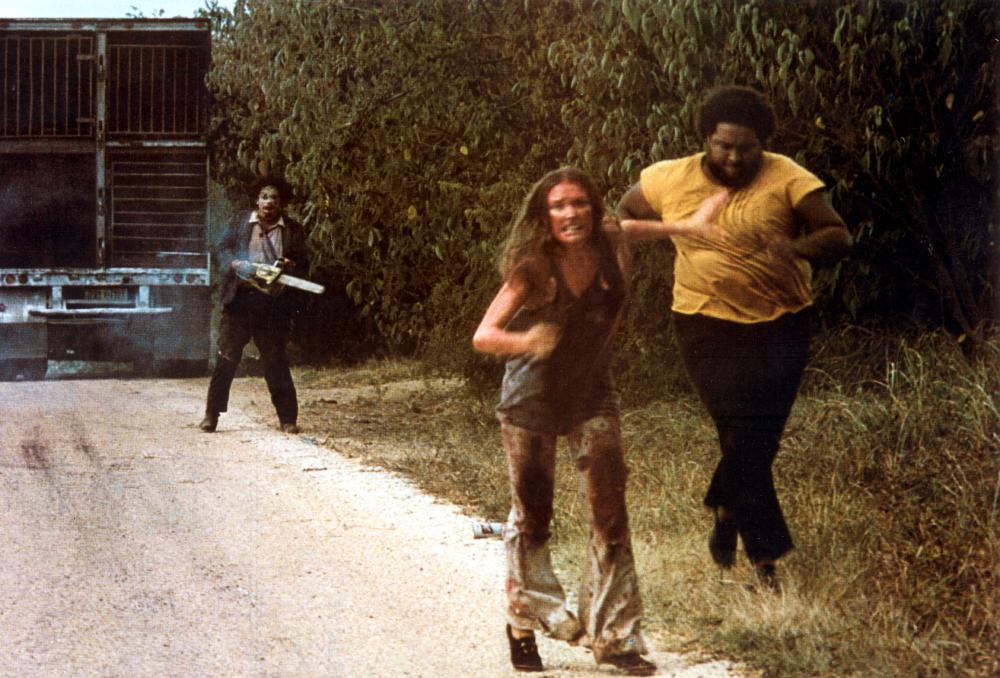
As the Hitchhiker is ejected from the van, he runs alongside it, smearing his blood across the surface. At first it seems like a frenzied flailing meant to freak them out, but on later inspection, there is a discussion of whether the mark means something. It does not appear to be random smears, but rather carries a runic quality.
Of course, could it just be random smears? Absolutely. But we’re in it now and magical thinking compels us to think about it. Through Pam’s astrology and the oddness of the hitchhiking shamanic figure, the audience is subconsciously prepped for this kind of thinking.
Does it add much directly to the story as it is going to play out? Not really. But it is all part of the occult undercurrent that runs through the film.
The Bird Nest (Visual Three)
The Hitchhiker is later revealed to be the person who was messing around in the graveyard, creating the grim tableau that opens up the film. Throughout the film we see the handiwork of the Hitchhiker presented through the production design by Robert A. Burns. Human skeletal remains entwined with furniture and fixtures, and animal remains displayed as decor – all designed by Robert A. Burns to evoke the real-life creations of Ed Gein. It turns the Sawyer home into a filthy, evil place, but curiously a form of altar or a shrine of the slaughterhouse. Some of the few lines of dialogue about the family, by the family, illustrate pride in their slaughterhouse work, culminating in a darkly hilarious scene where “grandpa” feebly tries to “knock” Sally in the head, but keeps dropping the hammer as the rest of the Sawyers cheer him on, hootin’ and hollerin’ about it. Our first sign of the slaughterhouse faith comes with the reveal of the corpses lashed together in a bizarre display early on, just after the credits. But something that sticks with me is something much smaller, later.
In the old Hardesty family home, our wheelchair-bound Franklin observes a strange display, appearing like a bird’s nest; its position and isolation in the room seems to give it an otherworldly quality, especially divorced from the context of the Hitchhiker’s other totemic creations seen later. The display looks like a bird’s nest resting on a pillow, decorated with various animal parts. It’s a deliberate design and rather subtle in comparison to the handcrafted horrors yet to come.
It is small and delicate, but indicates care, a seeming respect for it, like a religious object. But it’s all abattoir-like detritus, isn’t it? It’s the bits and pieces of dead things that likely found their end at the hand of the backwoods cannibal who arranged them. Why does this small display of craft and care fill me with such dread?
Quoting Stephanie Monohan in “Apocalyptic Americana” – “It is difficult to untangle The Texas Chain Saw Massacre from the historical and cultural context in which it was conceptualized: Tobe Hooper has never been cagey about the importance of the era’s political climate and how it made up the DNA of his film. The America he was exploring in 1974 was internalizing a downward spiral into social breakdown, facing an uncertain and unstable identity in a post-Vietnam, post-Manson country.”
Much like how Americans were facing an American apocalypse at the time the film was released – a breakdown of what American life was said to be – it seems, too, that the Sawyers faced their own apocalypse. Their existence owed to the slaughterhouse and being so casually cut off from it, it’s no surprise they went a little religious with its significance. Merchants of slaughter, slaughter becomes their faith and the remains of slaughter become totems. The god of flesh and bone, blood and gristle, gave them meaning, and in the void of its absence they try to recapture what they can. I am sure there is more to go with this, but this is only a very brief start to what might be a much larger topic. One I will probably need to watch the movie a few dozen more times to really try to explore.
This has been an installment of Graphic Content; support my writing by joining me on Ko-fi.
