


I’m trying something new this week, and I’ll run it for a bit to see what the response and engagement will be. I am likely to try all sorts of new things over the coming months, and your thoughts and interactions really have a major influence on it all.
This piece was inspired by a portion of my most recent blog, where I discuss a specific scene from The Odyssey (2026). So I am calling this series of posts “As Scene On,” where I’ll look at key scenes of media that I feel mean something important to said media.
For now, I am focusing on the prestige drama, Mad Men, a show very close to my heart.
Mad Men S1E1 – “Smoke Gets In Your Eyes”
The first writing I ever sold was a review of an episode of Mad Men, many years ago. It was in the early days of seriously pursuing my associate’s degree, and experiences in my English class had me thinking that, maybe, I could be a writer. I made about $2.50 on it, sold to some content-mill blog. I’ve sold a lot of pieces into the churn since.
I mention this because this feels like a little nostalgic homecoming for me. I have just started a Mad Men rewatch, and the nostalgia for the show is very powerful. It’s also been a very long time since I watched it, so it is about as close to fresh eyes as I can rally for the experience. I remember a great deal of the stories, character arcs, and scenes, of course, but the details around the edges are fuzzy.
I think it is the scenes that pull me back; slices of a story that really sell you on the overall experience. You may remember things around the margins, and you may recall the broadest strokes of an episode. For me, there is always a scene that stands out, Something that, even isolated, speaks to the larger experience.
And scenes can do so much. They can focus on a relationship, show a character shift, or present a thrilling sequence. They can be hilarious, heartbreaking, or aggravating. They can be multiple things at once. They are moments of time that you associate with the feelings about media you experienced – books, comics, film, and television.
Let’s look at the first episode of Mad Men.
The Static Don Draper
I had a client once for whom I wrote some articles and blog posts regarding creative topics: character design, writing, illustration techniques, and the like. One such post was about dynamic and static characters.
Don Draper is a static character. Do things happen to him? Yes. Does he make changes? Yes. But it’s all temporary. It is all an illusion of change.
The Don Draper we get in the first scene of the pilot episode of Mad Men, “Smoke Gets In Your Eyes,” is the same Don Draper we see on the edge of a cliff overlooking the sea in “Person to Person,” the final episode of the series. He is the same hollow man marketing himself to the public. He is entirely transactional.
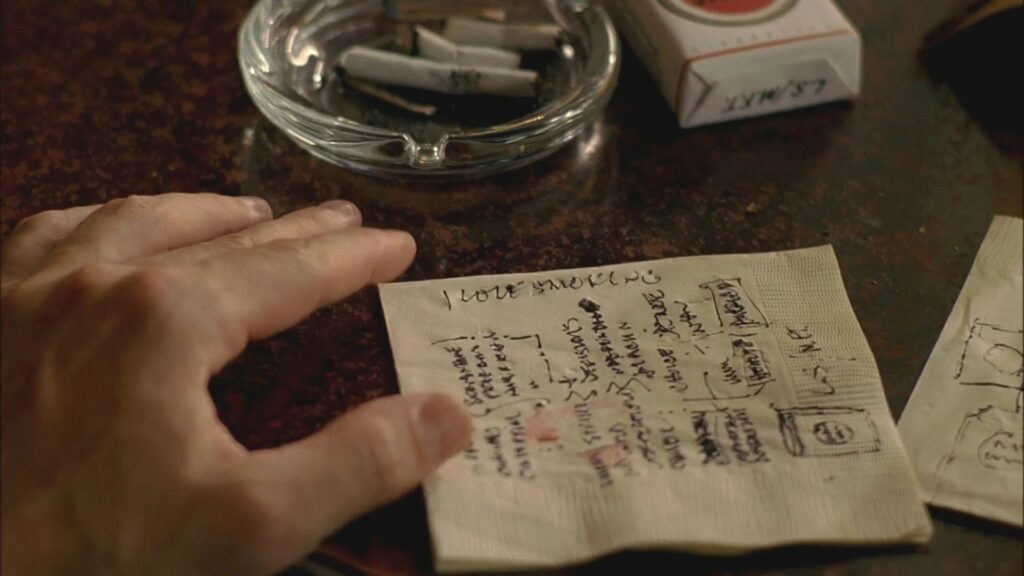
It is all handled beautifully in this very first appearance. The handsome (m)ad man in a smoky bar, scrawling on a cocktail napkin, is Don Draper (later also known as Dick Whitman – teased out over season one). A man who is a paper lantern projection of success. He looks the part of an ideal male of the period, but he is not in control of his own life and oozes a deep sadness that makes him covetous – Understandably so, as we’ll learn in the season ahead.
But in this moment, in the scene, he is a handsome, stoic man oozing masculine charm, grappling with how to market Lucky Strike cigarettes amid the increasing awareness of the health risks they pose. He’s a thinking man, an intellectual. Sure, his plight is about marketing cancer to Americans, but there is an art to the process, and it is work that has significance. Historical significance at that. So Don Draper sits in a lounge, smoking, drinking, man-ing. And he strikes up a conversation with an older black man, a busboy, about his cigarette brand of choice.
Don is white, handsome, and, for the most part, successful (remember the paper lantern?). He has the power in this exchange. It is March 1960 in the show, and anyone with any cursory knowledge of U.S. history should be shouting “CIVIL RIGHTS.” He is using this man in the guise of a friendly chat about his brand of cigarettes for market research. And that is not necessarily a bad thing. Don is looking for ideas. He is respectful enough here, speaking man-to-man, curious about habits and reasons for something as simple as why he smokes what he smokes. It is all above board here.
When the supervisor approaches, he snidely asks if the busboy, now identified as Sam, is bothering Don and that Sam can be a little chatty – just shy of calling him uppity, really. And that’s when the first transaction happens: a social exchange meant to get Don what he needs- an illusion of kindness.
A paper lantern of empathy.
The Unenlightened Don Draper
Don speaks to the supervisor, seemingly indignant and shocked by his behavior from management. They’re just having a chat; is that alright with him? The manager sheepishly drops his bullying of his black employee, offers to refill Don’s drink, and Don goes back to his chat. Sam is now much more willing to talk about his smoking habits with the white man who stood up for him. Don is a charmer, thrilled with the pursuit. He’s got Sam where he wants Sam.
There is the transaction.
Don looks like an enlightened man, standing up to a bully, and Sam is willing to discuss his smoking habits. Don looks good here in this moment, but as we learn more about him later on, we get the sense that his outlook on civil rights is seemingly apolitical. He is not any more or less racist than a lot of people he works with; this is the 1960s, Matthew Weiner is committed to a degree of realism, after all. But Don does not seem particularly enlightened or concerned with the struggle beyond what he can get from it.
It is hard to call Don Draper racist in the scope of the decade the series depicts; it is more that it is not about him and his pursuits, and only becomes something transactional, just like all of his relationships throughout the rest of the series. His empathetic outreach is like that paper lantern projection – weak and illusory. He’ll stand up for a black employee being browbeaten by a supervisor, but tolerate office Jew jokes. Sam mattered for a brief moment – it would be hard to imagine Don remembering him if he came into the same lounge the next day.
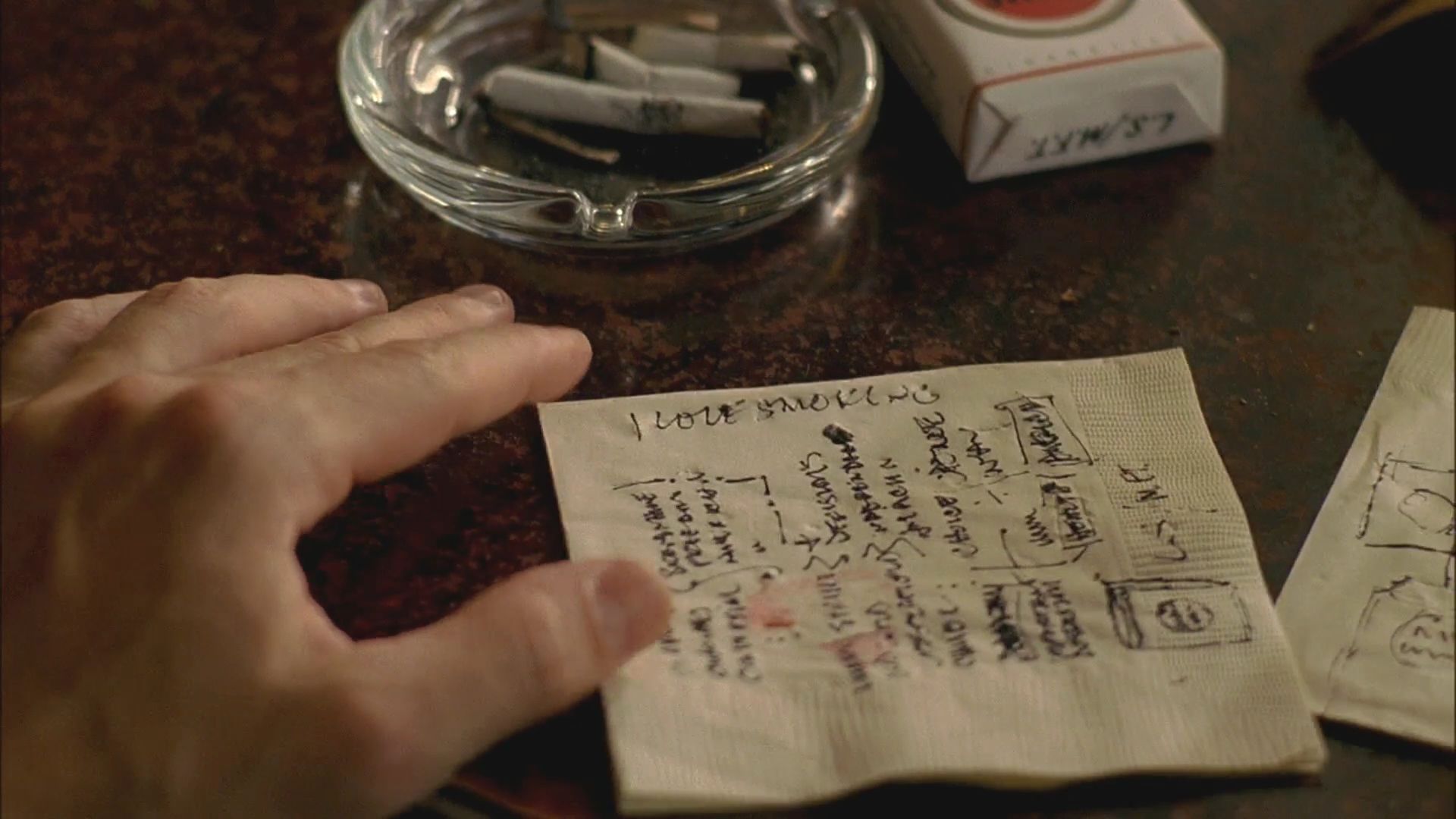
But, back to the scene, their discussion done, the camera pans down to see his cocktail napkin, scrawled with notes.1 “I love smoking,” among them, the insight of a working man. The not-so-hard-fought prize of illusory concern. The spoils of the transaction. One of many this shell of a human makes over the course of seven seasons, starting at this very scene.
That’s All For Now
That’s where I leave you for now. If you have seen the show before, rewatch the first few minutes of the pilot episode and think about what we see of Don Draper as the series reaches its end. I can understand that people might see Don in the final moments of having finally freed himself of his demons, or maybe at least coming to terms with them. But I simply cannot see it that way. I love Don Draper as a character, don’t get me wrong. But I love him because he is a mess who never learns to grow long enough to effect change.
If you have never seen Mad Men but want to start and have stumbled upon this post, please look closely at this scene and keep it in the back of your mind as you run through the episodes. I think you might see where I was going here.
If you want to see more of these posts, please comment and let me know. Share your thoughts. I was planning on running through the entirety of Mad Men‘s first season, at the very least. I also may dabble in some other media as well. It would be nice to pull out a scene from literary fiction as I get back into reading more regularly.
If you want to support the work that I do, consider following me on Ko-fi and subscribing for as little as $1 a month. As a subscriber, you help me cover the website’s costs, which is a big deal for me. You can even suggest articles for this very series; name a movie, book, show, or what have you, and let me know. I’ll gladly see what I can do.
Next time, “Ladies Room.”
- I’m thankful for kissthemgoodbye.net for the massive archive of episode screen captures, including the one featured in this image. Also, thanks to The Art of the Title for the show’s title card.
