

We’ll be wrapping the final three Halloween films, starting with Halloween (2018), following yesterday’s brief diversion into Clayface.
It’s been fun going back through the history of the franchise and sharing my thoughts. If you’ve been enjoying the posts, please let me know. Hopefully, this 31 Days of Halloween has been entertaining.
Now on to my second favorite of the Halloween films.

Halloween (2018) is my second favorite film of the Halloween franchise. It also serves as the best sequel to the original film from 1978, which is about as close to perfect a horror film as possible in my estimation, up there with the likes of The Texas Chainsaw Massacre, Dawn of the Dead, The Exorcist, and The Changeling. Halloween (2018) doesn’t quite hit those highs, but among the larger Halloween franchise, it is truly excellent.
We are inundated with legacy sequels of all kinds these days, and it can feel a little gross and cynical overall, with those exceptions of the legacy sequels that truly add something in conversation with their progenitors. Top Gun: Maverick did it. So too did David Gordon Green and Danny McBride with the first of the three legacy sequels to Halloween. As for why their take on Halloween lands so well, allow me to paraphrase George Lucas when he was discussing the structures of his original Star Wars trilogy and his in-production prequels: “it’s like poetry, it rhymes.”
Carpenter’s Halloween and Green’s Halloween have structural and thematic similarities that naturally play off one another to build to a larger whole, separated by nearly 4 decades of pop-culture history. The legacy sequel is so in sync with the film it follows up on that it feels like an organic extension of the themes and insights that first landed in theaters in 1978.
The structural continuity between the two films, separated by 40 years, is also matched within the sequel film itself, which builds on the hunting motif of the original and inverts and comments upon it in satisfying ways.
It’s Not a Cage, It’s a Trap
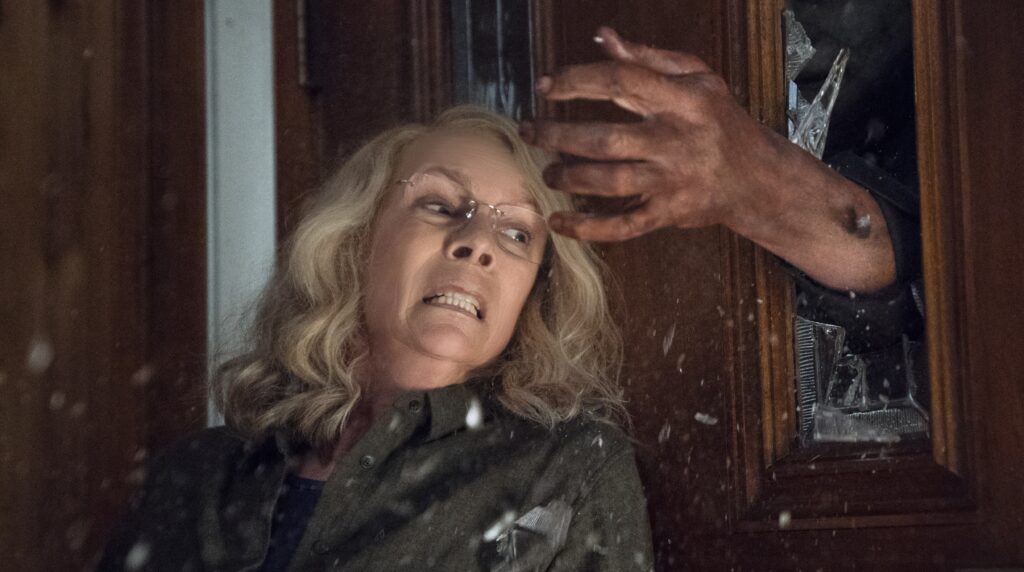
In Halloween (1978), the film is structured around parallel hunts through predatory figures. Obviously, Michael Myers tearing through Haddonfield is one, but one also needs to acknowledge Loomis’ predatory nature. Loomis is a hunter and would go to further and further extremes in other sequels, but in the context of the first film, he recognizes the threat of Michael and hunts his patient down, not above the tactics of the evil he stalks. Loomis is Michael’s mirror in many regards, and Laurie is a victim trapped in the struggle between two predators. Laurie survives that hellish night in Haddonfield, but in Halloween (2018) she has never really recovered from it.
There is a common theme in many of the films that feature the character of Sam Loomis – he has a certain kind of madness that inspires madness in the community around him. Halloween (2018) is no different, but instead isolates that madness to Laurie. Loomis showed her the boogeyman in no uncertain terms, and Laurie is forever haunted by that knowledge and touched by the same desire to destroy it as Loomis was.
When Laurie Strode meets Dr. Sartain, she refers to him as “the new Loomis,” but she is wrong. Loomis never wanted to know how Michael “worked” after the point of no return. He saw the evil and wanted it obliterated. Sartain wants to understand evil, even to the point of wearing Michael’s mask. Dr. Samuel Loomis would never. Sartain is a fool’s understanding of what Loomis means to the narrative. Laurie is the true successor.
It is in Laurie Strode being Samuel Loomis’ successor in his crusade that Halloween (2018) understands and builds on the structure of the first film. The film understands that to meet the original film on a fundamental level is to require two simultaneous hunts: The Shape hunting people in Haddonfield, and someone hunting The Shape.
There is an interesting moment in the film that discusses hunting. It’s part of a kind of rhythmic structure Green and McBride employ across their trilogy where a dialogue between characters establishes some humanizing quirk or development, makes them feel real, just to twist the knife as Michael Myers slaughters them. It becomes a bit of a joke in their follow-up, Halloween Kills (2021). But in their first film, it’s an interesting technique that doesn’t overstay its welcome.
The scene involves a father and his son out at night for a hunting trip. They discuss the hunt, and the son mentions he loves spending time with his dad on these things, but also loves dancing. The father is not entirely dismissive of it, which is a pretty 2000s touch to show how times have changed. The scene is mostly set up to get Michael from the bus crash to Haddonfield and also allows him to have a moment where he kills a child to raise the stakes. But the larger conversation on hunting feels thematically appropriate for what we’ll be seeing in the larger narrative.
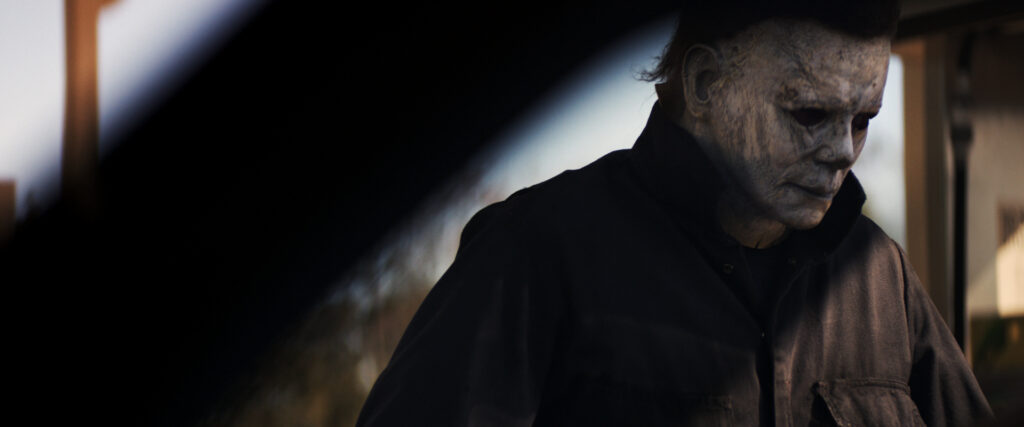
Five distinct hunting narratives are present in the larger film. There are, of course, Michael Myers’ stalking scenes, some of the best scenes in the film, but there is also Laurie’s hunt for Michael as she has waited 40 years for his return and prepared for it. While those are the real hunts that matter, there are three more that reflect people who don’t have the ability to live up to the task that was started by Loomis and taken up by Laurie. The podcasters meet their fate pretty quickly – their hunt for a story gets them involved far beyond what they had expected and murdered by Michael. There is also the manhunt for Michael by the Haddonfield sheriff’s department, but they are institutional power with an already terrible track record, as exemplified by Deputy Frank Hawkins (Will Patton), Michael’s original arresting officer in 1978, whose original sin was not doing what needed to be done and extinguishing the evil. Lastly, there is Sartain’s pursuit of understanding about why Michael Myers does what he does, which ends with him having his head squashed like a tomato.
But the core dueling hunt where predator and prey switch positions, exemplified by Michael and Loomis in the original film, is echoed here with Michael and Laurie. The film does several callbacks to the original, placing Laurie as the monster stalking Michael, and it’s satisfying. Her appearance from the shadows, echoing Michael’s appearance from the darkened closet in the original, may be one of the most satisfying callbacks in a legacy sequel ever. In 40 years since that fateful Halloween night, Laurie learned a lot, realizing that to take down the monster, it must be trapped; it can’t be left to escape like it did that night. Her obsessive desire for monster blood, her Loomisness, may have ruined her relationship with her family, but the brutal truth is that it was necessary and right because if Halloween has shown us anything, Michael may be just a person, but there is a darkness within him that must be extinguished. He is fundamentally antithetical to civilization as a concept and should not be permitted to exist.
Had the franchise ended there, with Laurie’s trap house burning down, and no sign of Michael Myers ever again, that would have been the perfect capper to the concept. Halloween 1978 and 2018 would have been a perfect one-two punch, well earned through time, which isn’t something always afforded to stories the way it should be.
But as we’ve seen time and time again, they just can’t let The Shape rest, can they?
This has been an installment of Graphic Content; support my writing by joining me on Ko-fi.