


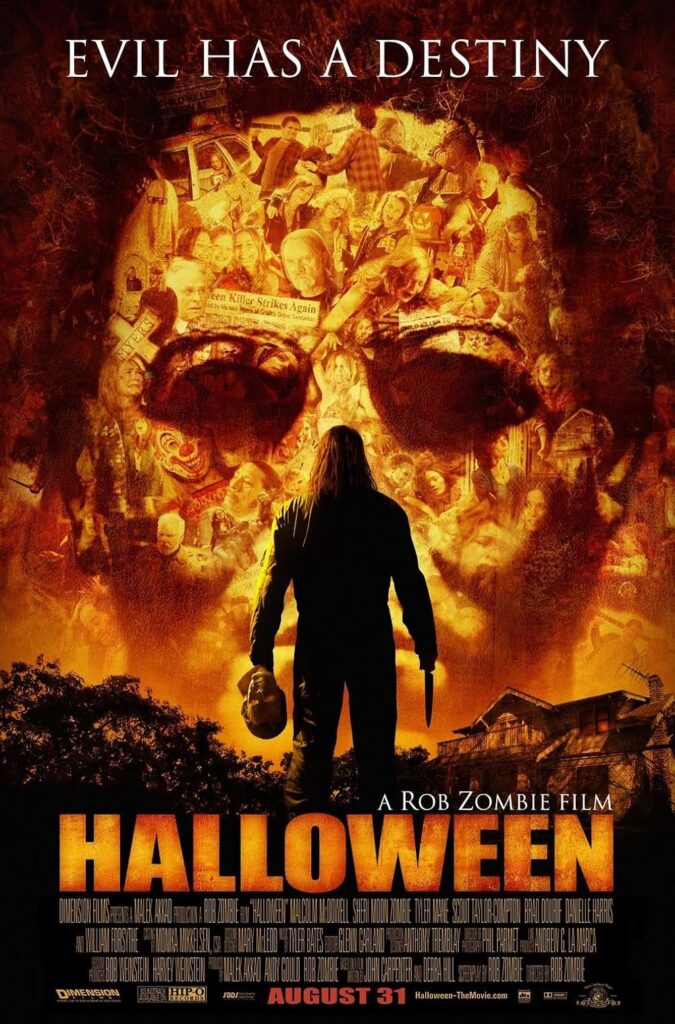
Our twentieth post for 31 Days of Halloween is Rob Zombie’s first Halloween film, Halloween (2007). It is a solid reboot with an edge that isn’t seen in many of the other films. Legitimately, Zombie’s duology is among the better two films in the franchise.
So, let’s look into this horror remake that doesn’t get enough credit for how well it works, shall we?
I actually enjoy Rob Zombie’s take on the Halloween series quite a bit. I’ve written about his Firefly trilogy back in 2024. While critical of elements of it, there are plenty of things to like. That is very much the approach I take to his take on Halloween (2007), but I find he is largely successful and the vision feels more consistent across the two films.
I think the concept of Laurie and Michael being siblings works here, unlike 1981’s Halloween II, because this film does the groundwork to make that part of the story, as opposed to the beer-soaked solution Carpenter devised to follow up the original. For most of the films in the franchise, I never find myself being able to buy into the secret sibling concept, but the key is that it is not secret to the audience in this film. One of the more ambitious changes in Zombie’s take on the Michael Myers story is an extended prologue that explores the disturbed family life of Michael before he commits his infamous murder on Halloween night. It then goes further, showing the kid regress into the mute monster he would eventually come to be known as in pop culture, though not entirely successfully. We see his broken family and disturbing mental state, and we see that he has an affection for his baby sister. We also come to find out how his sister became adopted, which is maybe one of the more interesting changes to the story for this movie.
Sheriff Brackett, played by the legendary Brad Dourif, reveals to Dr. Samuel Loomis (Malcolm McDowell) that he was the officer who arrived at the Myers house after Michael’s mother took her own life in grief at the destruction of her family and the madness of her institutionalized son. As the officer arrives, he sees baby Angel and does not want the innocent child to grow up with the stigma of being a tragic factoid her entire life. He does a bad thing for a good reason and hides details at the scene to leave her with an adoption service a county over.
But because there is always a strange twist of fate influencing the world around Michael Myers, the baby is adopted by the Strodes and raised as Laurie, unbeknownst to everyone but Brackett and her parents.
It’s so much more elegant than it was handled anywhere else in the series. There is a bit of a mysterious cosmic luck to keeping her so close to the site where she lost most of her family and where Michael could later find her, but that is the heightened reality of film that is pretty readily accepted. The mechanics behind explaining the circumstances work well enough to make the situation believable, creating genuine emotional stakes. I find it interesting that Zombie managed to crack the code in such a way as to make me actually like the sibling angle as much as I do.
A lot of that is due to that extensive opening that showcases a young (talking!) Michael Myers (played by Daeg Faerch). A lot of people tend to disparage this film as the “White Trash” Michael Myers movie, and to a degree, yes, that is a pretty apt description. The Myers family of Zombie’s remake is so broken that you’re practically eager to see that whole dysfunctional unit torn asunder due to how heightened their shittiness comes off. “Heightened” is actually the perfect word to describe a lot of the additions surrounding the characters in the remake. Michael’s first kill in the film isn’t even his sister Judith, but instead a rat, as Michael tortures and mutilates animals: psycho-killer 101. His second kill is a kid who bullied him at school, and it is brutal. Some of the kills in the film are some of the more gruesome in the series, and watching a 10-year-old boy beat another child to death with a tree branch goes to show this isn’t the same Michael Myers.
All that characterization, however, weirdly makes the character inconsistent within the film as well. Michael’s muteness doesn’t really make a whole lot of sense after he murders a nurse in Smith’s Grove. I understand this is a point of no return and the film needs him to be silent to create the menace he is so famous for, but at this point the kid had already murdered at least 4 people without regressing so significantly. It feels like a stretch based on what the film revealed about him until that point. There is the mask angle, a retreat from reality, but it just never quite feels earned.
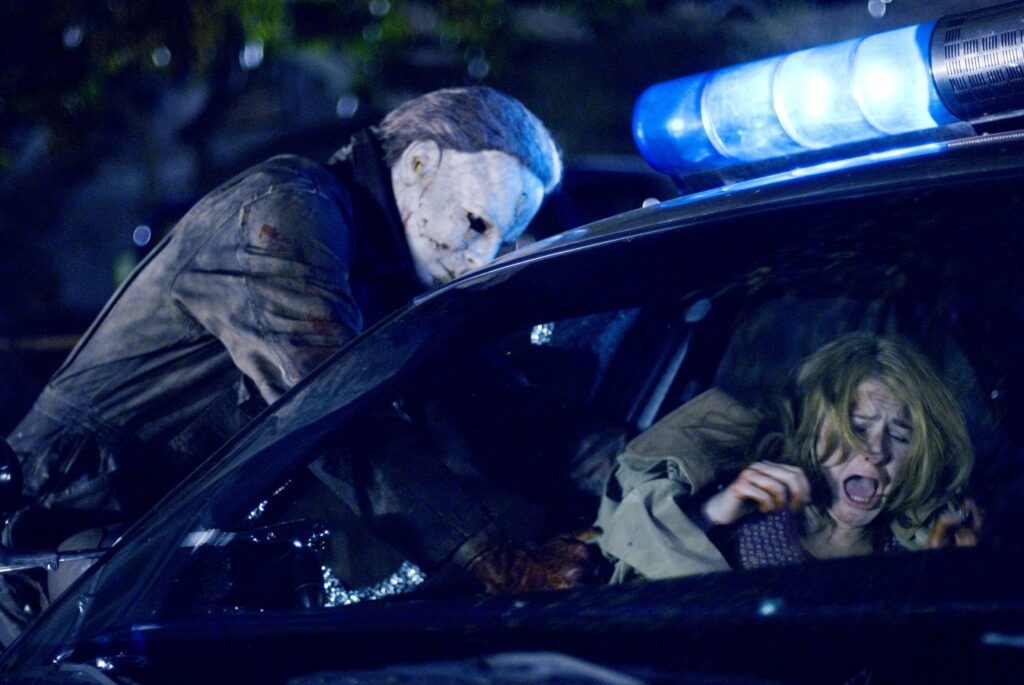
But that’s one of my only major complaints with the characterization of Michael in Halloween (2007). Largely, this might be my favorite Michael regarding his presence. The long-hair look on “pre-mask” Michael feels appropriate. I also think Tyler Mane might be the most beastly-looking version of the character. But some of the things I appreciate most about Michael in the film are his physicality – he will smash, kick, and bash through doors, and while he maintains the creepy walking pace for the most part, he will have sudden bursts of speed, again reflecting a more beast-like element of his characterization.
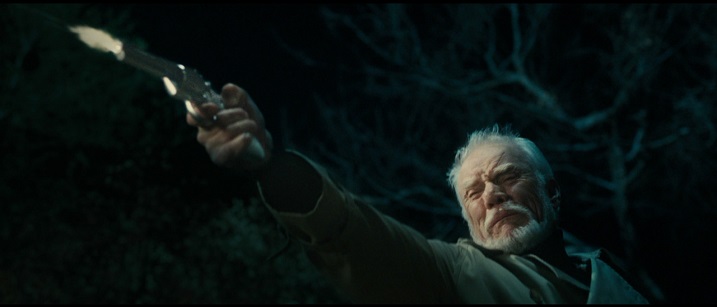
I also appreciate that the film does well by Loomis, giving him a pop-psychologist vibe, a man who wants to help but also sees the profit in the work he does, especially with such a fascinating patient. While Donald Pleasence’s Loomis was a man convinced he was fighting evil itself, Malcolm McDowell’s Loomis feels a little more cynical, willing to do what he can but recognizing some things are beyond his power. He pleads with Michael to stop his massacre, to leave Laurie alone, and you get the sense maybe his concerns are more financial than altruistic. The fact that it is unclear if he is dead or not at the end of the film, his skull crushed by Michael’s bare hands, is a brilliant change. A man who built a life around this patient and squeezing out a strange and exploitative relationship with him now has his fate sealed by how hard that patient decides to squeeze back.
There is a lot to really like about Rob Zombie’s take on Halloween, and I think between it and Halloween II (2009) we end up with one of the better duologies of films in the franchise. It is certainly the story that seems far less beholden to past continuity than previous attempts. About an hour of the runtime of Halloween (2007) may be a remake of the original film, but it is the stuff that is outside the framework that ends up being the boldest and most interesting changes to what we know.
And best of all, it’s only going to get even bolder with Rob Zombie’s Halloween II.
This has been an installment of Graphic Content; support my writing by joining me on Ko-fi.

[…] the story he is trying to tell. Case in point, I was a little down on Michael Myers’ muteness in the previous film. I felt the transition from a talking child to the silent killer we expect from a Halloween film […]