



Here we are with essay #5 of 31 for this 31 Days of Halloween Vol. II project. The last post was about complicated feelings on ghost hunting; today it is Godzilla and the power of his design. I’ve dropped that label from the post titles because it makes the SEO much more manageable, just being under Graphic Content.
This one is a bit of an interesting variation on what I’ve done before. This is me working from a prompt that I assign to my students, and this week we are covering Godzilla in class. The prompt in question: “Using this week’s readings, lecture, and an outside source, explain your theory as to why the Godzilla franchise has achieved the longevity it has over the decades and what role the tone shift between eras suggests about the monster.”
I decided I would tackle it to share with my students later as a demonstration of how such a prompt can be addressed. Of course, I will be providing them with an MLA-formatted version, with a dedicated Works Cited page. Readers of the blog get the blog version.
Anyway, feel free to share your thoughts.
I am going to reveal something that seems obvious, but I feel we don’t talk enough about: part of the appeal of monsters is that they often look cool. Horrifying and disgusting sometimes, but for a sizable portion of people, I would wager that “looking cool” is a major factor in a monster’s appeal. And no monster out there exemplifies that more than Godzilla, first introduced in the classic 1954 film by Ishiro Honda. Here is a monster evoking horrid trauma while representing childhood fantasy – what could be cooler?
While by today’s standards of CGI and an entire industry of creature design, his original look can be seen as quaint, at his atomically enlarged core, the existing design concept is incredible. Even though the creature, conceptually, is rooted in deep, national trauma, there is still something inherently appealing about the look. Much of the appeal of the original design, elements of which survive and thrive today, comes down to contrast. As Peter H. Brothers wrote in “Japan’s Nuclear Nightmare: How the Bomb Became a Beast Called Godzilla,” Toho Studios Producer Tomoyuki Tanaka saw the production as a way to cash in on special effects films, but director Ishirō Honda had far darker thoughts, later reflecting, “I wanted to make radiation visible.” 1954’s Godzilla is at once a dark visual metaphor for atomic disaster while being a mass-market-appealing icon.
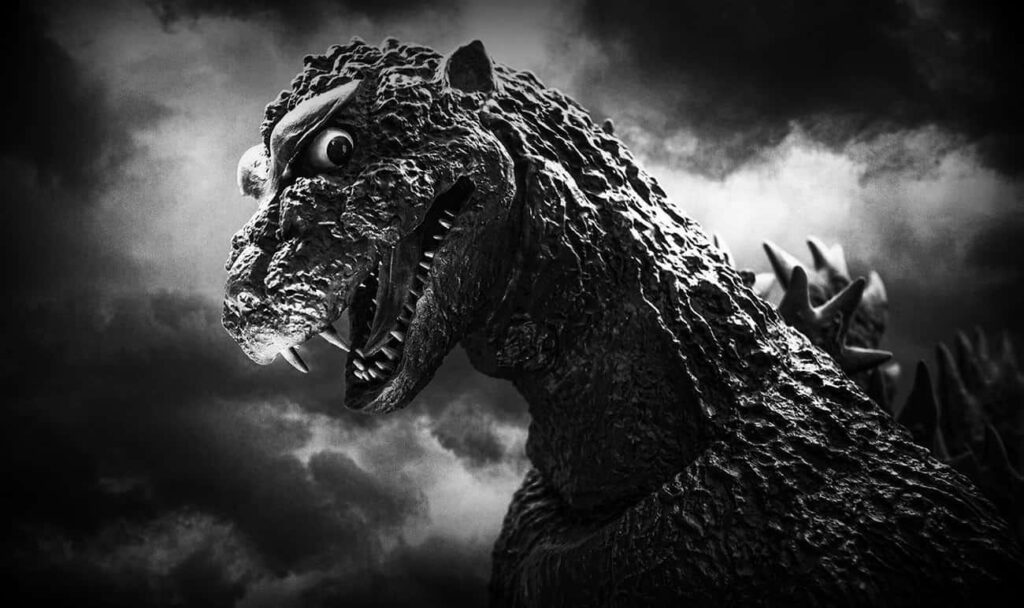
As a mass-market icon, it’s hard not to take notice of the importance of the kaiju’s design in the promotion of Godzilla: King of the Monsters! (1956) in the United States. As Gregory Pflugfelder writes in “Godzilla: A Monster in Midtown Manhattan,” “Amid the kaleidoscopic array of American cultural icons lining Times Square in 1956, a four-story green monster (Godzilla is conventionally gray in Japan) fit in with perfect ease” (116). This is one of the first elements of design that has allowed Godzilla to remain a timeless and persistent monster in film: scale.
While different takes on Godzilla have varied wildly in height, the kaiju is consistently dominant in scale compared to the world around it. In horror, there is a frequent concept of awe, from which the sensation of horror derives. The Horror genre’s three dominant aesthetics are terror, horror (sensation), and revulsion. Godzilla’s size is directly connected to the concept of horror as a sensation. Terror is the expectation of something, horror is the awe of the reveal, and revulsion is the reaction. Smelling death, seeing the corpse, and finally vomiting. Imagine the first sailors to see a whale at sea. Think of the awe and the horror of it. How can a creature be so large? Extreme scale is scary. Buildings, canyons, seas, and the cosmos – all create unease in most. Every version of Godzilla taps into that – often the marketing. Godzilla is larger than life and demands notice. The size of Godzilla is the first design hook that makes a statement.
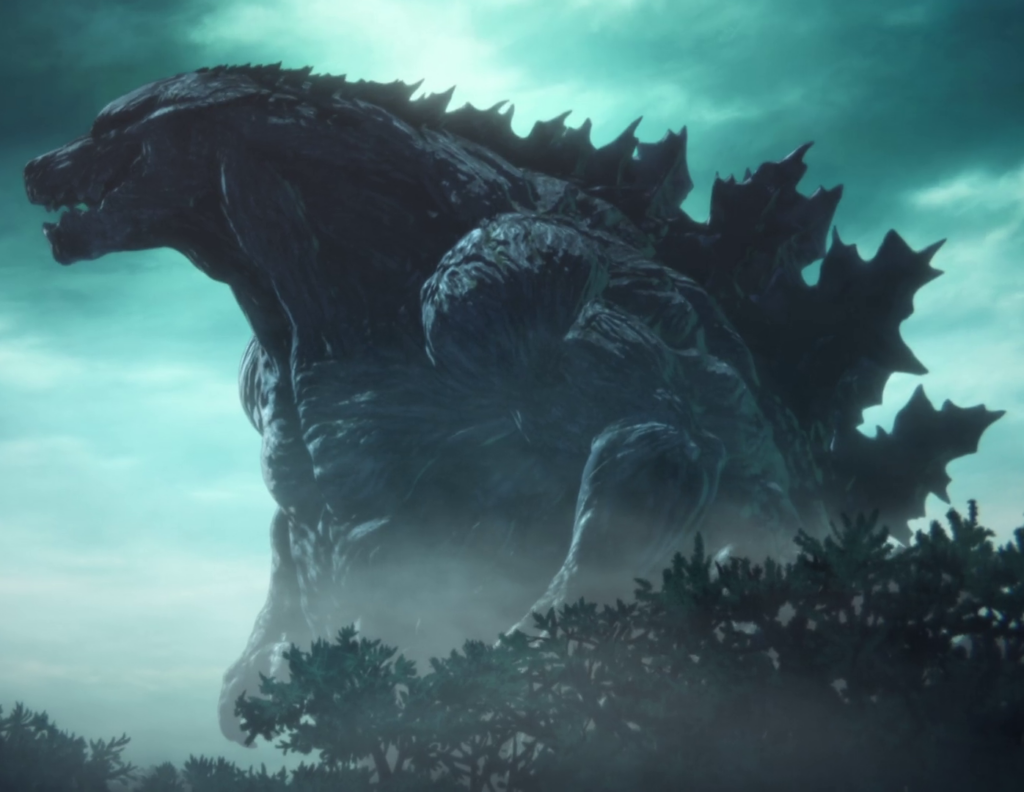
Godzilla’s atomic edge comes in many forms that prove adaptable for different tones. His skin is crackled and burned, almost charred, even in 1954. It’s unclear where keloid scars begin and reptile scaling ends. Godzilla’s head evokes the atomic cloud in some shots, and early design concepts emphasized this very look. Godzilla’s dorsal spines jut from the beast’s back like hostile architecture and glow with ionization. All these design elements evoke an atomic anxiety. Combined with scale, there is an inherent horror applied to the monster.
Another thing that needs to be acknowledged for understanding Godzilla’s design appeal is that the creature is a variation of the beloved theme of the dinosaur. Godzilla, in many respects, is the platonic ideal of a dinosaur. A Tyrannosaurid body, the limbs and neck of an Iguanodon, and the plates of a Stegosaurus, a fusion of popular dinosaur species that children obsess over. Ask a child to draw a dinosaur, and more than likely the end result is Godzilla-esque. If it were possible to find someone who had never seen a Godzilla film and asked what they were looking at, the answer would almost certainly be: ‘a dinosaur.’ After all, dinosaur obsession is a phase in the lives of many youths; “Many children develop a love of dinosaurs at an early age, but most of the time, they don’t become world-renowned paleontologists” (Marples). That dinosaur appeal is nearly universal and taps into something, forgive the pun, primal in the human mind. Yet, Godzilla’s silhouette is complicated by deliberate non-reptilian features – a hybrid monstrosity of Tyrannosaurus and an upright humanoid. There is a complexity to the organism on a conceptual level that varies from project to project. Inherently a technical issue due to the suitmation process to depict the kaiju, it lends Godzilla at times a clumsy and sometimes unnerving human quality.
But just as Godzilla can inspire horror, the beast is a mass marketing miracle, and the beast can be adorable, too. Godzilla’s “humanity” from the suitmation process permits a level of expression one might not expect from an atomic dinosaur. Much of this also comes down to the design of the kaiju’s expressive face, with surprising details and influences.

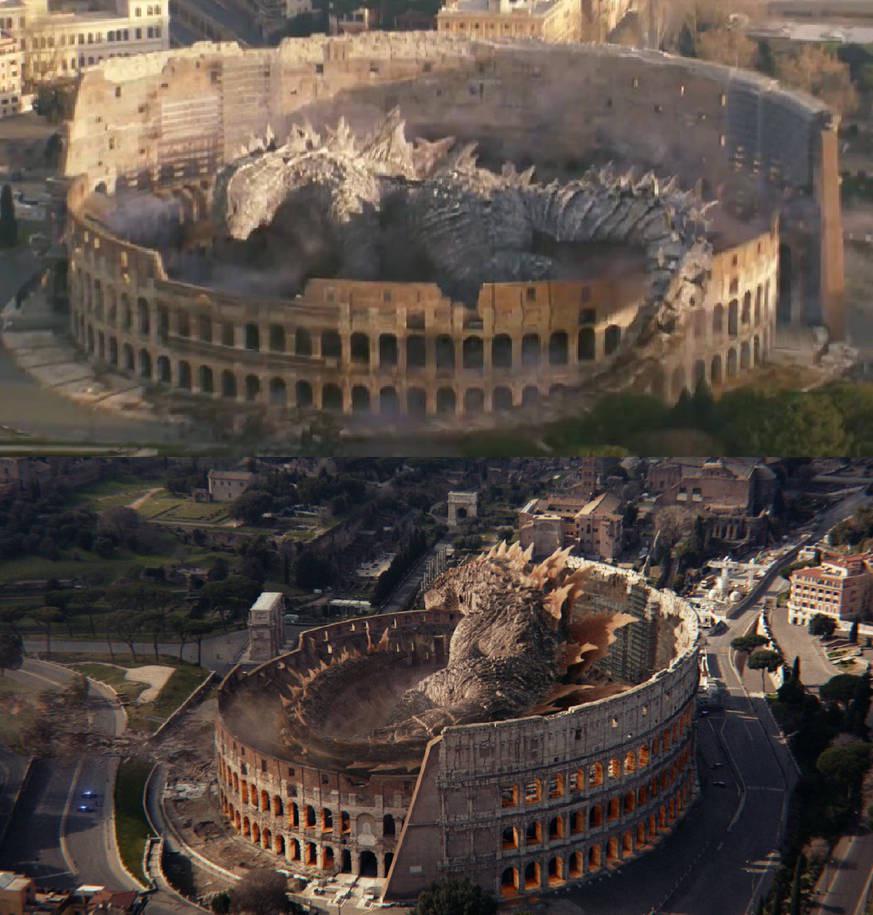
Godzilla’s cute appeal, or kawaii-ness, can and has been emphasized frequently as a marketing tactic. But even his 1954 appearance has several cute elements that lend the design to easy adaptation to mascotification. One feature that can escape notice is adorable, tiny ears. Further, Godzilla’s face and demeanor do have some cat-like elements that have been pushed in various features. One fun example is in Legendary Studios’ Godzilla X Kong: The New Empire (2024), where a resting Godzilla turns the Colosseum in Rome into a makeshift cat bed, curled up just like a feline.
Godzilla’s present-day film immortality is a combination of launching with a powerful, influential debut film and the inherent “cool factor” of the kaiju’s design. Godzilla’s awe-inspiring scale, combined with the nostalgic, dinosaur-adjacent silhouette, provided the monster with an instantly recognizable and appealing profile. Meanwhile, the subtle mammalian traits of Godzilla provide an expressive range that filmmakers would readily incorporate in different ways; Godzilla, an atomic chameleon, could play the world-ender, the clown, the mascot, and the hero. Godzilla’s visual design, all the way back in 1954, is almost a perfectly engineered canvas that allowed the monster to outlive the atomic era that birthed it.
This has been an installment of Graphic Content; support my writing by joining me on Ko-fi.
