



We’re now 3 essays into the possible 31 for the 31 Days of Halloween project, so who better to write about than the glorious Vincent Price?
Today I want to set aside some time to write about Vincent Price, and since I recently watched The Last Man on Earth (1964), this felt like a great opportunity for that. Is it the best movie Vincent Price has ever been in? Absolutely not. It is still quite fun, and his performance is what keeps the film afloat, given that he’s the only character for about 70% of the runtime.
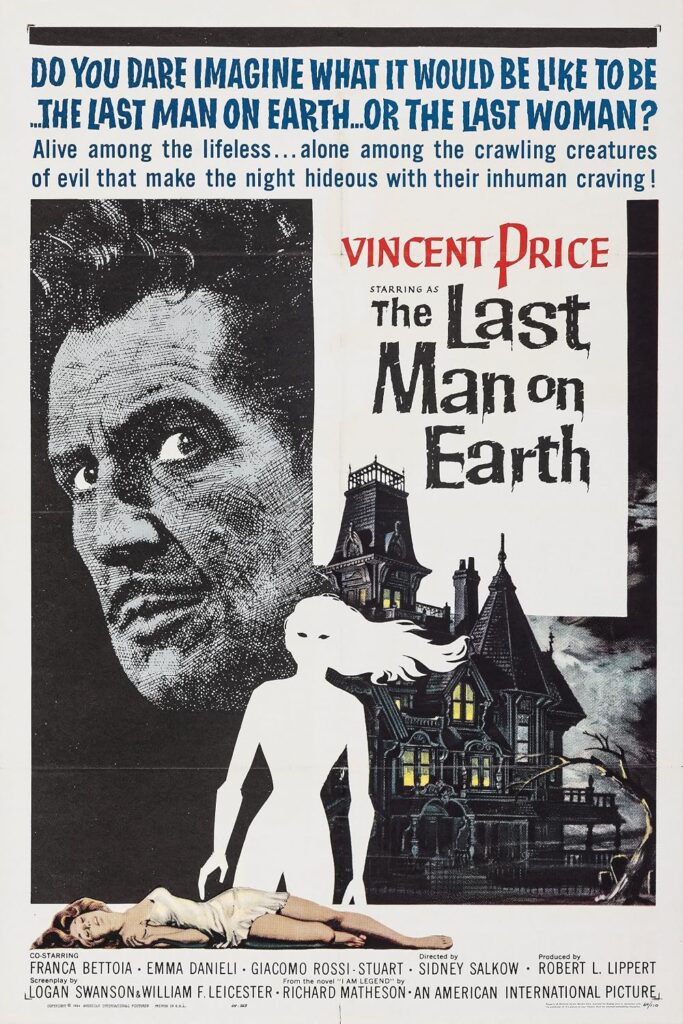
If you like this movie, you probably like it because of him. As an adaptation of Richard Matheson’s novel, I Am Legend (1954), there isn’t a lot going for The Last Man on Earth. Of course, as I covered a little bit of Italian dream logic yesterday, we get a solid dose of that in The Last Man on Earth as well, given it is an American/Italian co-production. Matheson was a co-screenwriter of the film, but ultimately washed his hands of it by taking the credit through a pseudonym, Logan Swanson.
The film’s central conceit is that an apocalyptic plague has wiped out most of humanity, converting most survivors into vampire-zombies. Vincent Price plays Dr. Robert Morgan, an immune man who appears to be the last living human in his area. (Aside from mentions of the plague’s European origins, the film is far from worldly, encompassing only about a dozen blocks in a non-specific city, but shot in Rome with Mussolini’s fascist flair adding another layer of unease.) The film explicitly calls them vampires, yes, but watching it with the knowledge of George Romero’s Night of the Living Dead releasing just a couple of years later, you can’t help but see the zombie parallels in how the vampires act – well, some vampires.
It turns out this rapidly mutating plague has also resulted in rapid mutation in the vampire populace, where enough vampires have wits among them to create a drug that can help mask their symptoms, at least to get close to Robert. Eventually, Robert meets his doom, learning that his daily hunts of nesting vampires, hammer and stake and all, amount to him being a genocidal murderer – he is the monster they fear, and in their fear they destroy him.
It’s a perfectly fine concept that has been around so long that it doesn’t really come off as a shock anymore. Part of that comes from the ubiquity of the film on television and being thrown into the public domain in the 1980s. That’s why I can embed the entire film right here, see?
Ultimately, The Last Man on Earth lacks the depth of Matheson’s original novel, but as a science-fiction horror film, it has the kind of B-range quality that makes it appealing. The film also feels much older than it actually is. If you were to tell me it was released in the mid-to-late 1950s, I would believe you. Part of that comes from some of the limitations of American-Italian film production. But part of it is just that the world presented does not feel specifically like the 1960s.
Other than Vincent Price being Vincent Price, a lot of the film feels disposable and hackneyed. Not necessarily the fault of the production, but the film’s twist has been done so many times that unless you knew the novelty of it at the time of release, you’re probably not gonna feel much of an impact from it. There are also all sorts of dream logic elements that can pull one out of the film. How is the garlic at the grocery store still so fresh after three years, even with refrigeration? How has Robert Morgan not found signs of the more evolved vampires earlier? All of these are things you can handwave away as you watch, but they’re inconsistencies regardless.
But at least we have Vincent Price.
Living Dead Man
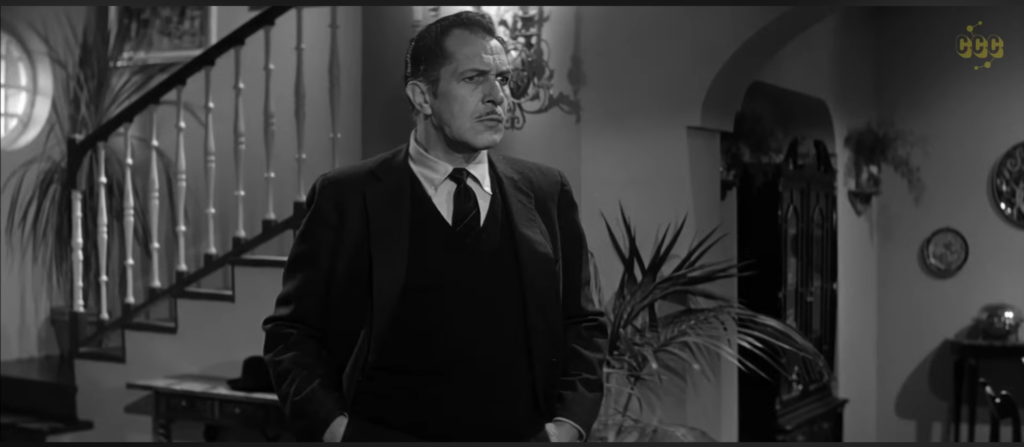
Despite some of the creeping dream logic in The Last Man on Earth, Vincent Price carries the film. For major portions of the runtime, he is the only face we see and the only voice we hear. It takes real skill to remain compelling under such circumstances, but he is very up to that task.
I think the film is at its best in the beginning, before his flashback to the pre-plague days. The bleakness of the abandoned city and strewn bodies carries a lot of tension, and the juxtaposition of Price as Dr. Morgan going through the monotonous routines says so much. You could probably edit out his voiceover entirely and still get what is going on just from the weariness of his body and the bored look on his face. This is a man who is already dead. He’s mad, and undertaking his grand task is doing him no favors.
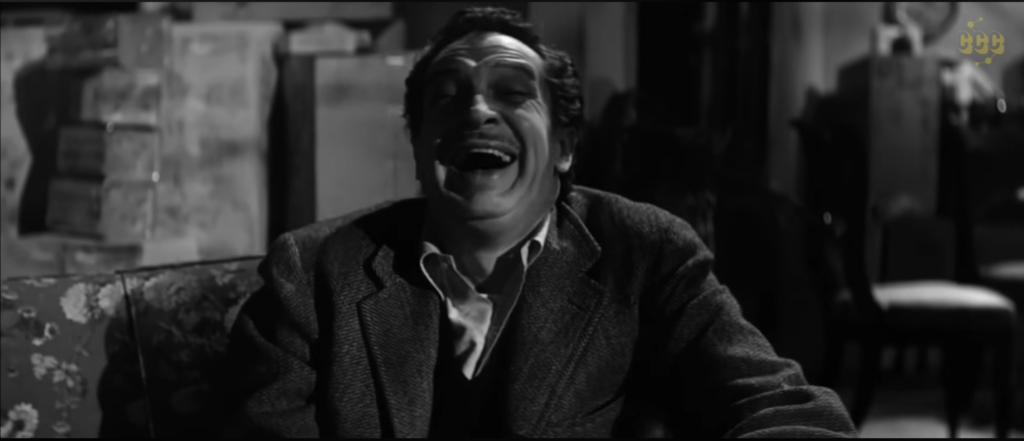
Of course, probably the scene people may most remember was him watching curiously edited home movies (again, this is a partially Italian film; there is going to be jank – you get the sense he didn’t actually shoot these things in-world) showing his life before the plague – showing his daughter, wife, and his friend Ben. It’s made all the more eerie as the vampiric Ben is right outside the door of the house, banging on the walls and calling “Morgan! Morgan!”
In that moment, as Morgan watches these home movies, we really get a sense of the weight he carries alone, in this terrible wasteland. He laughs at circus performances and smiles at the sight of his wife and daughter – but enough time passes that his indulging in nostalgia drives him to madness yet again. Laughter becomes strained, exhausted sobbing – all the while, the vampires continue to bang on the walls and beckon him out.
No words are needed here. It’s just a tired, lonely man having a breakdown on the couch as the world outside wishes to consume him. It’s beautiful in its bleakness.
Nobody could do it quite like Vincent Price.
Vincent Price: Spooky Queer Horror Daddy
As a child, my first conscious memory of Vincent Price was the 13 Ghosts of Scooby-Doo and Michael Jackson’s Thriller. But as I found myself exploring movies, I started catching him in a lot of classic films and, colliding with my love of Poe, dove fully into his series of Poe adaptations with Roger Corman. And of course I saw Edward Scissorhands at a formative age, which was among his final roles.
Growing up as a weird and spooky kid, overweight, and socially toxic (self-inflicted, I assure you), there was something about Vincent Price as an individual that spoke to me. Around high school, I began to read more about him and his life and began to see him as an icon in so many ways.
The man was also sexy, very much in the sense of a Renaissance man with a worldly quality, delightful demeanor, and embracing many talents. My wife has mentioned that she had a crush on him as a kid. Thinking about it now, maybe I did too? I think many people might find him still quite sexy today, as he’s more than an actor but an icon that has come to represent so much. He was an outside figure on the inside – a successful actor who, in a lot of ways, fit the archetype of ‘weird outsider,’ refined and so beloved today. (Think about David Dastmalchian in the world now, who borrows from what Price had been up to.)
I own two of Vincent Price’s cookbooks. Did you know he could cook? Fans would, but I don’t know if it’s very common knowledge among people who know him as the guy in the spoken-word part of Thriller. I mean, of course the man could cook – he needed to eat. But that he had a particular culinary interest, enough to publish recipes – that’s fascinating. He had a cooking show in the U.K., Cooking Price-Wise, that I have never seen, but gosh do I want to see it.
He was an art historian as well, perhaps foreshadowing his later queer iconicity; quite the tastemaker. He appreciated art in all forms, and for many Americans in the 1960s and 1970s he contributed to the spread of art in the home. His partnership with Sears is a particularly interesting note of his long career in the arts. I live close enough to The Vincent Price Art Museum, but I have never gone. That is something I need to do at some point.
He was also a queer icon as well, and this aspect of his life has become more known as the years go on. Married to three women and having two children, Price would become a very public supporter of LGBT causes. Price himself was bisexual, and at least two of his marriages were lavender. Victoria Price, his daughter, recalls understanding something about her dad’s sexuality at nine years old, looking back at her father’s close company.
But Price is not a perfect man; any icon has their darker aspects. An icon is only a human we’ve collectively put on a pedestal, and all humans have their failings. The man was, at one time, antisemitic and a Nazi sympathizer. But this wasn’t lasting – by his late twenties, his political views grew greatly, and he shook off those problematic beliefs, going fully liberal. I think there is something to admire in that growth and that willingness to change. In fact, he ended up being greylisted as “Premature Anti-Fascist,” part of Sen. Joseph McCarthy’s whole communist witch-hunt. This is weird, right? He fell in with the goosesteppers as a young man, changed his views, and then was treated as a radical by Sen. Joseph McCarthy, who harbored some anti-Semitic views of his own. Price had a brief Nazi-fling and then became anti-Nazi too early for McCarthy. Life moved very quickly back then, apparently.
Is it disappointing that Vincent Price held problematic views for a time? Yes, absolutely it is. But also, is it that surprising for a young man to be a shithead – even one who came off as beloved and refined as Vincent Price? We have young shitheads today who have fallen in with loud and hateful demagogues. With luck, they too will follow Vincent Price’s growth.
Vincent Price outgrew his cringe. I can only hope one day we all can outgrow ours. Vincent Price is proof you can stay spooky, make some mistakes, but still be beloved.
But, what do you think? Are you a fan of Vincent Price? Any particular memories or outstanding roles? Let me know in the comments.
This has been an installment of Graphic Content; support my writing by joining me on Ko-fi.
